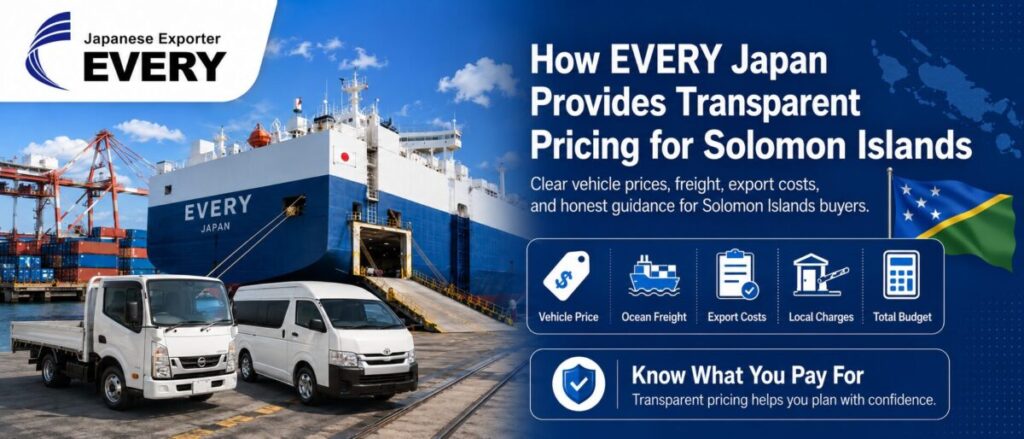

Importing a Japanese used vehicle is a major investment for a Solomon Islands buyer.
The vehicle may support a delivery business, farm, school, church, hotel, contractor, or passenger service.
Therefore, buyers need more than an attractive advertised price.
They need clear information about the vehicle, freight, export work, payment, and destination costs.
Transparent pricing helps buyers understand what the quotation includes.
It also explains which costs remain payable in Solomon Islands.
As a result, buyers can prepare a more realistic budget before sending money.
EVERY Japan supports this process with vehicle-specific quotations, clear communication, and detailed export information.
This guide explains how that approach helps Solomon Islands buyers make safer and more practical decisions.
Why Transparent Vehicle Pricing Matters in Solomon Islands
A vehicle price from Japan represents only one part of the import budget.
The buyer may also need to pay freight, insurance, bank fees, customs charges, port costs, registration, and local delivery.
Moreover, buyers outside Guadalcanal may need another domestic sea journey.
A vehicle for Malaita, Western Province, Choiseul, Isabel, or Makira may require coastal shipping after Honiara clearance.
Therefore, a low Japanese price does not always create a low final cost.
Transparent pricing helps the buyer separate each stage.
It reduces confusion between the vehicle price and the complete landed cost.
This is especially important for small businesses.
Many Solomon Islands operators have limited working capital.
They may need to keep funds for fuel, wages, customs, repairs, and business stock.
Consequently, one unexpected charge can affect the whole business plan.
What Transparent Pricing Really Means
Transparent pricing does not mean that every future cost can remain fixed.
Shipping schedules, exchange rates, port charges, and customs decisions can change.
Instead, transparent pricing means that known costs appear clearly.
It also means that uncertain costs receive a clear explanation.
A useful quotation should show:
- The selected vehicle price
- Japanese inland transport, when applicable
- Export handling and documentation
- Ocean freight
- Marine insurance, when requested
- The agreed shipping term
- The destination port
- The payment currency
- The quotation validity period
- Costs not included in the quotation
Therefore, buyers can see what they will pay to the exporter.
They can then estimate the remaining Solomon Islands expenses separately.
EVERY Japan Prices the Actual Vehicle
Every used vehicle has a different condition and specification.
Year, mileage, engine, transmission, body type, payload, and equipment affect its value.
Therefore, EVERY Japan provides a quotation for the selected unit.
The quotation should not rely only on a general model price.
For example, two light trucks may share the same model name.
However, one may have a flatbed body and low mileage.
The other may have a dump body and higher mileage.
Their purchase prices and freight costs may differ.
Likewise, a bus with working air conditioning may cost more than a similar bus needing repairs.
Vehicle-specific pricing gives the buyer a clearer comparison.
Clear Vehicle Details Support Clear Pricing
A price has little value without accurate vehicle information.
Therefore, buyers should receive enough details to understand the unit.
Important information includes:
- Make and model
- Year of manufacture or registration
- Chassis number
- Engine capacity
- Fuel type
- Transmission
- Drive system
- Mileage or operating hours
- Passenger capacity
- Maximum loading capacity
- Overall dimensions
- Vehicle weight
- Body type
- Available equipment
These details also affect freight and customs planning.
For example, a taller body may increase shipping space.
A heavier vehicle may also cost more to move between islands.
Photos and Videos Help Buyers Judge Value
Solomon Islands buyers usually cannot inspect the vehicle in Japan.
Therefore, photographs and videos play an important role.
EVERY Japan can provide visual information for the selected vehicle.
Buyers should review:
- Front, rear, and side photographs
- Cabin and seat condition
- Dashboard and odometer
- Engine compartment
- Chassis and underbody
- Tyres and wheels
- Cargo body or passenger area
- Cold-start condition
- Engine-running condition
- Special equipment operation
As a result, the buyer can compare price with visible condition.
A slightly higher price may offer better long-term value.
Vehicle Price and Freight Appear as Separate Costs
Ocean freight can form a large part of the import budget.
Therefore, buyers should know whether freight appears separately or inside the total quotation.
A clear quotation identifies the vehicle amount and shipping amount.
This helps the buyer understand why two vehicles have different totals.
For example, a compact van may use less vessel space than a long bus.
A light truck may also cost less to ship than a heavy commercial truck.
Consequently, vehicle size can change the final quotation even when purchase prices look similar.
EVERY Japan Explains FOB, C&F, and CIF Pricing
Shipping terms can cause confusion for first-time buyers.
Therefore, the quotation should state the correct term clearly.
FOB Pricing
FOB normally covers the vehicle and agreed Japan-side export costs.
The buyer arranges or pays the main ocean freight separately.
This option can suit experienced importers.
However, it may require more shipping knowledge.
C&F Pricing
C&F normally includes the vehicle and ocean freight.
Marine insurance usually remains separate.
This option can make budgeting easier for many Solomon Islands buyers.
However, local destination charges remain outside the quotation unless stated otherwise.
CIF Pricing
CIF normally includes the vehicle, ocean freight, and marine insurance.
Still, insurance terms and coverage limits can differ.
Therefore, the buyer should request the policy details.
Insurance does not normally replace a mechanical inspection.
Japanese Inland Transport Is Explained
A vehicle may sit far from the chosen export port.
It may come from an auction, dealer, supplier, or storage yard.
Therefore, Japanese inland transport can affect the total price.
A low-priced vehicle in a distant location may cost more to collect.
Meanwhile, a slightly higher-priced vehicle near the port may offer a lower export total.
Transparent pricing identifies whether inland transport appears in the quotation.
This helps buyers compare vehicles on the same basis.
Export Handling and Document Costs Are Identified
Exporting a vehicle requires administration and port preparation.
The work may include document preparation, booking, measurements, and port delivery.
It may also include storage before the vessel sails.
Therefore, export-related costs should not appear as an unexplained amount.
EVERY Japan can explain the Japan-side services included in the quotation.
These may include:
- Export documentation
- Vehicle measurement
- Shipping booking work
- Port delivery arrangements
- Loading preparation
- Document dispatch
- General export administration
EVERY Japan Does Not Treat Local Costs as Japanese Charges
Some import costs arise only after the vehicle reaches Solomon Islands.
The Japanese exporter does not control every local fee.
Therefore, responsible pricing separates exporter charges from destination charges.
Possible Solomon Islands costs include:
- Customs duty and other import charges
- Customs broker fees
- Shipping agent fees
- Delivery order fees
- Port handling charges
- Wharfage
- Biosecurity inspection
- Cleaning or reinspection
- Storage charges
- Registration
- Number plates
- Local transport
- Provincial sea freight
These amounts can depend on local rules and service providers.
Therefore, buyers should confirm them with the relevant Solomon Islands organisations.
Customs Costs Require an Honest Estimate
Customs charges can form a major part of the landed cost.
However, an exporter should not promise a final customs amount without official confirmation.
The assessment can depend on vehicle classification, customs value, freight, and other details.
Therefore, EVERY Japan can provide the documents and vehicle information needed for an estimate.
The buyer can then contact a Solomon Islands customs broker.
Useful information includes:
- Commercial invoice value
- Vehicle make and model
- Chassis number
- Year
- Engine capacity
- Fuel type
- Body type
- Passenger capacity
- Freight amount
- Insurance amount
Most importantly, the declared value should match the genuine transaction.
A false low invoice can cause delays, reassessment, or penalties.
Port and Shipping Agent Costs Remain Clearly Separate
Ocean freight pays for international transport.
It does not usually cover every cost at Honiara or Noro.
After arrival, the shipping agent may charge for documents and cargo release.
The port may also charge for handling, wharf use, lifting, or storage.
Therefore, the buyer should request a local estimate before the vessel arrives.
This prevents the buyer from confusing freight with destination handling.
Biosecurity Costs Need Special Attention
Commercial vehicles can carry soil, seeds, leaves, and other organic material.
Tractors and construction machinery face a higher contamination risk.
Therefore, buyers should consider cleaning before shipment.
Important areas include:
- Tyre treads
- Wheel arches
- Chassis rails
- Suspension parts
- Engine bay
- Radiator area
- Load body
- Toolboxes
- Steps and cabin floor
- Farm attachments
Professional cleaning creates an extra Japan-side cost.
However, it may reduce cleaning, storage, and reinspection expenses after arrival.
Transparent pricing explains whether cleaning appears in the quotation.
Marine Insurance Remains Optional and Clear
Some buyers want marine insurance for extra shipping protection.
Others may choose a quotation without it.
Therefore, insurance should appear as a separate item or clear inclusion.
The buyer should understand:
- The insured value
- The main covered risks
- The claim process
- The deductible
- Required photographs and documents
- Important exclusions
Clear insurance information prevents false expectations.
It also helps the buyer decide whether the added cost provides suitable value.
Payment Currency and Bank Fees Are Explained
Japanese exporters may quote in Japanese yen or United States dollars.
However, Solomon Islands buyers often hold Solomon Islands dollars.
Therefore, the final local payment cost depends on the exchange rate.
The bank may also charge transfer and processing fees.
A clear proforma invoice states the payment currency.
It also shows the exact amount due to the exporter.
Buyers should ask their bank about:
- The current customer exchange rate
- International transfer charges
- Correspondent bank charges
- Beneficiary bank charges
- The amount the exporter will receive
- The estimated processing period
This step reduces payment shortages.
It can also prevent shipment delays.
Quotation Validity Helps Buyers Manage Exchange Risk
Vehicle stock and freight conditions can change.
Exchange rates can also move between quotation and payment.
Therefore, a quotation should include a validity period.
The buyer should complete payment or request an updated quotation within that period.
This protects both sides from relying on outdated figures.
It also creates a clearer purchasing decision.
Transparent Pricing for Light Trucks
Light trucks support many Solomon Islands businesses.
They carry shop stock, water, produce, furniture, hardware, and building supplies.
A MITSUBISHI CANTER can suit urban deliveries and small construction work.
A TOYOTA DYNA may offer practical capacity for Honiara businesses.
Likewise, an ISUZU ELF can support regular commercial transport.
A HINO DUTRO provides another compact truck option.
However, even similar trucks can have different prices.
Body type, payload, tyres, mileage, and condition all matter.
Therefore, EVERY Japan prices the selected unit rather than quoting one general light-truck figure.
Transparent Pricing for Medium Trucks
Construction, wholesale, and infrastructure businesses may need more payload.
A HINO RANGER can support heavier cargo and equipment work.
An ISUZU FORWARD may suit flatbed, tipper, or box-body applications.
A MITSUBISHI FUSO FIGHTER can serve demanding commercial operations.
Medium trucks usually create higher freight and tyre costs.
They may also require more expensive provincial transport.
Therefore, transparent pricing considers dimensions and destination as well as the vehicle price.
Transparent Pricing for Vans
Vans provide flexible transport for staff, tools, passengers, and protected cargo.
A TOYOTA HIACE VAN can suit hotels, schools, contractors, churches, and delivery companies.
However, price differences may reflect roof height, seating, transmission, and air-conditioning condition.
Freight may also change with the vehicle dimensions.
Therefore, buyers should compare the complete quotation and vehicle specification.
Transparent Pricing for Buses
Schools, churches, hotels, companies, and tour operators may need passenger vehicles.
A TOYOTA COASTER can serve group transport.
A MITSUBISHI ROSA may support staff or community services.
A NISSAN CIVILIAN offers another practical option.
Bus prices depend on seating, body size, interior condition, and air conditioning.
Furthermore, a longer bus normally creates a higher freight amount.
Therefore, EVERY Japan can explain both vehicle and shipping factors.
Transparent Pricing for Rural Pickups
Rural buyers often need higher ground clearance and four-wheel drive.
A TOYOTA HILUX may suit farms, plantations, contractors, and field teams.
A TOYOTA LAND CRUISER PICK UP can support heavier rural work.
However, a four-wheel-drive badge does not explain the full value.
Buyers should also check tyres, suspension, underbody, and 4WD operation.
A clear quotation works best when supported by clear condition information.
Road Conditions Affect the Best Vehicle Price
The cheapest vehicle may not suit Solomon Islands roads.
Many provincial routes include gravel, mud, potholes, and damaged edges.
Heavy rain can also increase wear and reduce access.
Therefore, buyers should consider ground clearance and suspension strength.
Tyre availability also matters.
A rare tyre size can create extra expense and downtime.
Transparent pricing supports better decisions when combined with local-use planning.
Island Delivery Can Change the Best Choice
Many vehicles first arrive through Honiara.
However, the buyer may operate on another island.
Therefore, the final delivery route should influence vehicle selection.
A long bus or heavy truck may cost more on a domestic vessel.
A smaller truck may fit local wharves and landing craft more easily.
Before purchase, buyers should confirm:
- Domestic vessel availability
- Maximum vehicle dimensions
- Maximum cargo weight
- Loading method
- Unloading method
- Wharf access
- Crane or ramp availability
- Domestic freight cost
EVERY Japan can provide the vehicle dimensions needed for this planning.
Transparent Pricing Does Not Hide Vehicle Condition
A cheap vehicle can become expensive after repairs.
Therefore, price transparency also requires condition transparency.
Buyers should understand visible defects before payment.
They should check:
- Engine starting condition
- Exhaust smoke
- Oil and coolant leaks
- Transmission operation
- Brake condition
- Tyre condition
- Chassis rust
- Suspension wear
- Cabin condition
- Body equipment
This information helps the buyer compare price with expected repair costs.
Fixed Dealer Stock Pricing Supports Easier Budgeting
Dealer stock normally has a set asking price.
Therefore, buyers can make a faster cost comparison.
They can review the vehicle, quotation, freight, and destination estimate before payment.
This approach may suit first-time Solomon Islands importers.
It reduces uncertainty from competitive bidding.
However, buyers should still compare condition and total cost.
Auction Pricing Requires a Clear Maximum Budget
Japanese auctions can provide a wider vehicle selection.
However, the final purchase price depends on bidding.
Auction fees and inland transport may also apply.
Therefore, EVERY Japan should explain the expected cost structure before bidding.
The buyer should set a clear maximum bid.
That limit should leave room for freight and Solomon Islands clearance.
Otherwise, the buyer may win the vehicle but exceed the complete budget.
Clear Pricing Helps First-Time Importers
First-time importers often find international vehicle prices confusing.
They may not know which costs belong to Japan.
They may also misunderstand freight and destination charges.
Therefore, a simple step-by-step quotation provides strong value.
A first-time buyer should receive answers to these questions:
- What is the vehicle price?
- What Japan-side costs apply?
- How much is ocean freight?
- Is insurance included?
- Which port will receive the vehicle?
- What documents will the exporter provide?
- Which Solomon Islands costs remain?
- When must payment arrive?
- How long is the quotation valid?
Clear Pricing Helps Commercial Fleet Buyers
A fleet buyer may import several trucks, vans, or buses.
Therefore, small pricing differences can create a large total change.
A clear unit-by-unit quotation supports better accounting.
It also helps the business compare:
- Purchase cost per vehicle
- Freight per vehicle
- Expected customs cost
- Fuel use
- Payload
- Maintenance needs
- Expected income
As a result, the buyer can choose the most productive fleet mix.
Clear Pricing Builds Long-Term Business Trust
A successful export relationship continues after one transaction.
Solomon Islands businesses may need replacement vehicles, fleet additions, or farm machinery later.
Therefore, trust has long-term value.
Clear pricing supports that trust.
The buyer knows what the exporter includes.
The exporter also understands the buyer’s budget and business needs.
Consequently, future transactions can become faster and easier.
How Buyers Can Check a Quotation
Before payment, compare the quotation with a simple checklist.
- Correct exporter name
- Correct buyer name
- Correct vehicle make and model
- Correct chassis number
- Correct stock number
- Vehicle price shown clearly
- Freight shown clearly
- Insurance inclusion stated
- Shipping term stated
- Destination port stated
- Payment currency stated
- Bank beneficiary stated
- Quotation expiry stated
- Excluded costs explained
Never pay when important information remains unclear.
Ask for a corrected quotation first.
Questions to Ask EVERY Japan Before Payment
- Is this quotation FOB, C&F, or CIF?
- Does the price include Japanese inland transport?
- Does the price include export handling?
- What is the exact ocean freight amount?
- Does the quotation include marine insurance?
- What are the vehicle dimensions?
- Which documents will I receive?
- Has the vehicle received cleaning?
- Which costs remain payable in Solomon Islands?
- How long is this quotation valid?
- When must the full payment arrive?
- What happens if the vessel schedule changes?
Questions to Ask a Solomon Islands Customs Broker
- What tariff classification may apply?
- What customs value information do you need?
- What is the estimated customs amount?
- What is your broker fee?
- Which original documents are required?
- When should clearance preparation begin?
- Could inspection create extra costs?
- What may delay vehicle release?
Questions to Ask the Shipping Agent
- What delivery order charge applies?
- Which local documents do you need?
- What port charges may apply?
- How much free storage time is available?
- When do storage charges begin?
- Can the vehicle leave under its own power?
- What payment must be completed before release?
A Practical Transparent Pricing Formula
Buyers can use a simple formula for planning.
Japan quotation + customs estimate + port and agent estimate + registration + local delivery + initial maintenance.
Then, add a contingency reserve.
The reserve can cover exchange-rate changes, delays, cleaning, or a small repair.
This formula gives a more useful figure than the advertised vehicle price alone.
Example: Honiara Delivery Truck
Consider a Honiara retailer buying a light truck.
The business needs daily transport for cartons, furniture, and hardware.
The buyer first reviews the vehicle price and condition.
Next, EVERY Japan provides the freight and export quotation.
Then, the buyer asks a broker for a customs estimate.
The buyer also contacts the shipping agent about destination fees.
Finally, the business adds registration and initial service costs.
This process shows the expected total before payment.
Example: Provincial Passenger Bus
A church or school may need a bus outside Guadalcanal.
The buyer must calculate more than the Japan-to-Honiara cost.
Domestic sea freight may add a large amount.
Unloading facilities may also limit vehicle size.
Therefore, the buyer requests dimensions before choosing the bus.
The final decision balances seating capacity, freight, and local access.
Transparent pricing supports this complete comparison.
Example: Rural Farm Pickup
A plantation operator may need a pickup for workers, tools, and produce.
The lowest-priced pickup may have worn tyres and weak suspension.
Another unit may cost more but need fewer repairs.
Therefore, the buyer compares condition and landed cost together.
The stronger unit may offer better long-term value on rough roads.
Common Pricing Mistakes to Avoid
- Looking only at the Japanese vehicle price
- Comparing FOB and C&F quotations directly
- Forgetting inland transport in Japan
- Assuming ocean freight includes port charges
- Ignoring exchange-rate costs
- Forgetting customs broker fees
- Ignoring biosecurity cleaning
- Forgetting provincial sea delivery
- Using the full budget before clearance
- Choosing a vehicle without checking dimensions
- Accepting an unclear invoice
- Requesting a false customs value
Why the Lowest Price Is Not Always the Best Price
A low price can look attractive at first.
However, repairs and delays can remove the saving.
A cheap truck with worn tyres may need immediate replacement.
A low-priced bus with broken air conditioning may require major work.
A rare model may create long parts delays.
Therefore, the best price balances condition, freight, suitability, and ownership cost.
Transparent pricing makes that balance easier to see.
Final Advice for Solomon Islands Buyers
Transparent vehicle pricing starts with a clear quotation.
However, it also requires honest information about condition and excluded costs.
EVERY Japan helps buyers understand the vehicle price, freight, export work, and available insurance options.
It can also provide the vehicle information needed for local cost estimates.
Meanwhile, Solomon Islands buyers should confirm customs, port, registration, and domestic delivery costs locally.
They should also keep a reserve for servicing and unexpected delays.
Most importantly, buyers should compare the complete landed cost.
A suitable and reliable vehicle can support real business growth.
Clear pricing helps that investment begin with confidence.


Browse Reliable Used Trucks & Buses from Japan
Carefully selected vehicles ready for export worldwide
Search 100,000+ Dealer Stock Vehicles from Japan
Access a wide selection of vehicles from Japanese dealers nationwide. Updated daily.
