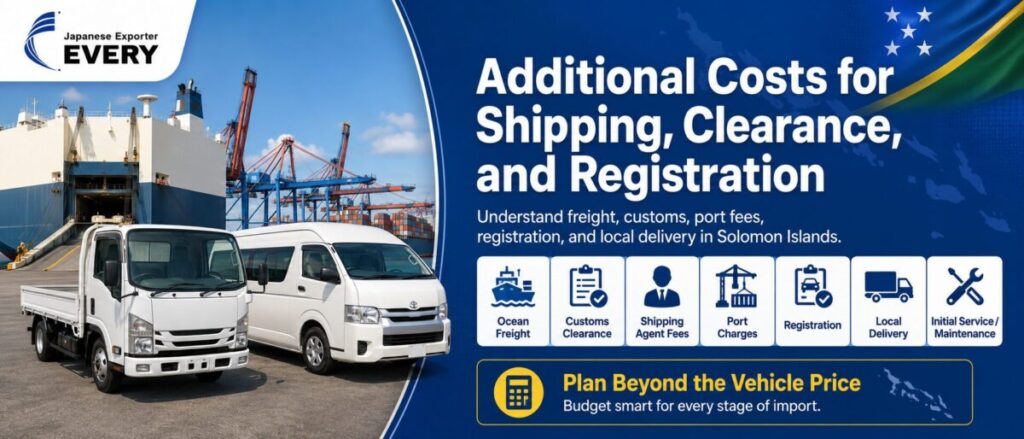

A Japanese used vehicle may show an attractive purchase price.
However, that price rarely represents the final cost in Solomon Islands.
Shipping, customs clearance, port handling, registration, and local delivery all add to the total.
Moreover, some costs appear only after the vehicle reaches Honiara.
Therefore, buyers need a complete landed-cost plan before sending payment.
This guide explains the main additional costs in simple English.
It also covers the needs of Solomon Islands businesses, farmers, contractors, schools, churches, and transport operators.
Why the Advertised Vehicle Price Is Not the Final Cost
Japanese vehicle listings usually focus on the vehicle itself.
Some quotations include freight, while others do not.
Likewise, most quotations do not include Solomon Islands destination charges.
As a result, two similar vehicles can have very different final costs.
For example, one vehicle may have a low price in Japan.
However, it may sit far from the export port.
Therefore, Japanese inland transport can reduce the original saving.
Another vehicle may have a slightly higher purchase price.
Yet it may have lower freight, better tyres, and fewer repair needs.
Consequently, it may offer the stronger overall deal.
A complete import budget should cover four main stages:
- Costs inside Japan
- International shipping costs
- Solomon Islands clearance costs
- Registration and operating costs
Start with the Correct Shipping Term
Before comparing prices, check the shipping term on the invoice.
The most common terms include FOB, C&F, and CIF.
Each term includes different costs.
Therefore, buyers should never compare quotations without checking the term.
FOB Price
FOB usually covers the vehicle and export handling in Japan.
The buyer normally pays the main ocean freight separately.
This option may suit experienced importers with shipping contacts.
However, it can create extra work for a first-time buyer.
C&F Price
C&F normally includes the vehicle and ocean freight.
However, marine insurance usually remains separate.
It also does not normally include Honiara port charges.
Therefore, the buyer must still prepare destination funds.
CIF Price
CIF normally includes the vehicle, freight, and marine insurance.
Still, the policy may offer limited protection.
For example, it may not cover normal wear or mechanical failure.
Therefore, ask for the insurance terms before payment.
Cost 1: Japanese Inland Transport
The vehicle must move from its current location to the export port.
It may come from an auction, dealer yard, company fleet, or private seller.
Japan has many auction and storage locations.
Therefore, inland transport can vary greatly.
A vehicle near Yokohama, Kobe, or another loading port may cost less to move.
Meanwhile, a vehicle in a distant region may need a long truck journey.
Large commercial vehicles can create higher transport costs.
These include buses, dump trucks, heavy trucks, and machinery.
Before buying, ask whether the quotation includes:
- Auction collection
- Dealer-yard collection
- Transport to the exporter’s yard
- Transport to the shipping port
- Temporary storage in Japan
- Port entry or handling charges
This cost can change which vehicle offers the best value.
Cost 2: Export Handling and Documentation
The exporter must prepare the vehicle for shipment.
This process includes more than driving it to the port.
The exporter may need to measure, inspect, photograph, and document the vehicle.
It may also need export-related administration.
Common export costs can include:
- Export documentation
- Port booking work
- Vehicle measurement
- Vehicle photography
- Storage before sailing
- Loading preparation
- Document courier charges
- Bank and administration fees
Ask for a clear invoice breakdown.
Then, confirm which services the exporter includes.
Cost 3: Vehicle Cleaning and Biosecurity Preparation
Clean vehicles reduce the risk of biosecurity delays.
This point matters for trucks, pickups, tractors, and construction machinery.
Mud, seeds, leaves, insects, and plant material can remain underneath a vehicle.
Therefore, a quick exterior wash may not provide enough cleaning.
Important areas include:
- Tyre treads
- Wheel arches
- Chassis rails
- Suspension parts
- Engine bay
- Radiator area
- Load body
- Cabin floor
- Tool compartments
- Underbody guards
Farm tractors and machinery need even closer cleaning.
Soil can remain around axles, linkages, blades, and attachments.
Professional cleaning in Japan creates an extra cost.
However, it may prevent larger costs after arrival.
Cost 4: Ocean Freight
Ocean freight often forms a large part of the import budget.
The amount depends on vehicle size, weight, route, and shipping method.
Shipping schedules can also affect the price.
Moreover, larger vehicles use more space on the vessel.
Therefore, a long bus or tall box truck may cost more than a compact vehicle.
RoRo Shipping
RoRo means roll-on and roll-off shipping.
The vehicle moves onto the ship through a ramp.
This method commonly suits running cars, vans, buses, and trucks.
It may reduce packing and container-loading costs.
However, the vehicle normally needs to start, steer, and brake.
Loose cargo may also face carrier restrictions.
Container Shipping
Container shipping can protect the vehicle during transport and handling.
It may suit compact vehicles, tractors, parts, and combined cargo.
However, loading and securing create extra expenses.
The buyer may also pay container handling and unloading charges.
Therefore, compare the full container cost with RoRo shipping.
Freight Depends on Vehicle Dimensions
Shipping companies may calculate freight from vehicle dimensions.
Length, width, and height all matter.
For that reason, body type affects the shipping cost.
A high-roof van may cost more than a standard-roof van.
Likewise, a long bus may cost more than a shorter bus.
Cost 5: Marine Insurance
Marine insurance adds another cost to the shipment.
However, it can protect against specific transport risks.
Insurance conditions differ between policies.
Therefore, buyers should ask several questions.
- What types of loss does the policy cover?
- Does it cover major shipping damage?
- What deductible applies?
- Which documents support a claim?
- How quickly must damage be reported?
Take photographs when the vehicle arrives.
Also, report visible shipping damage before moving it far from the port.
Cost 6: International Bank and Currency Charges
Japanese exporters often request payment in Japanese yen or United States dollars.
Solomon Islands buyers may hold funds in Solomon Islands dollars.
Therefore, currency conversion affects the final cost.
The bank may also charge several fees.
- International transfer charge
- Foreign exchange margin
- Correspondent bank fee
- Receiving bank fee
- Document handling fee
A transfer fee may look small beside the vehicle price.
However, exchange-rate differences can add a larger amount.
Ask the bank for the full amount needed.
Also, confirm how much the exporter will receive.
A payment shortage can delay shipping.
Cost 7: Shipping Agent Charges in Solomon Islands
The local shipping agent handles important arrival documents.
The agent may issue a delivery order after payment of its charges.
This order helps the buyer continue the release process.
Shipping agent costs can include:
- Delivery order fee
- Documentation charge
- Agency fee
- Manifest-related charge
- Communication fee
- Late document fee
Ask the agent for an estimate before the vessel arrives.
Furthermore, confirm which documents the agent needs.
Cost 8: Customs Broker Fees
Vehicle imports require a customs declaration.
Many buyers use a certified customs broker for this work.
The broker prepares and submits the import declaration.
The broker may also communicate with Customs and other agencies.
Broker fees can depend on:
- Vehicle type
- Number of vehicles
- Document quality
- Complexity of the declaration
- Additional inspections
- Urgency of the clearance
A broker adds a service cost.
Nevertheless, an experienced broker can reduce mistakes.
Contact the broker before shipment.
Then, provide the invoice and vehicle details early.
Cost 9: Customs Duty, Tax, and Import Charges
Customs charges can form a major part of the landed cost.
The final amount depends on the current tariff classification and customs value.
Vehicle type, engine details, use, and other factors may matter.
Therefore, do not use an old social media post as your tax estimate.
Instead, provide full details to Customs or a licensed broker.
Useful information includes:
- Vehicle make
- Vehicle model
- Year of manufacture
- Chassis number
- Engine capacity
- Fuel type
- Passenger capacity
- Vehicle body type
- Purchase price
- Ocean freight
- Marine insurance
- Country of export
Customs may review the declared value and supporting documents.
Therefore, keep accurate invoices and payment records.
Never request a false low-value invoice.
Incorrect information can cause delay, reassessment, or penalties.
Cost 10: Customs Inspection
Customs may inspect the imported vehicle.
The inspection can confirm the cargo and supporting documents.
Officials may compare the chassis number with the invoice.
They may also review the declared vehicle details.
An inspection may not always create a separate large charge.
However, it can create indirect costs.
For example, the buyer may pay extra storage during a delay.
A broker may also charge for additional attendance or document work.
Cost 11: Port Authority Charges
Port charges remain separate from ocean freight.
Solomon Islands Ports Authority may charge for handling and use of port facilities.
The amount depends on the cargo and service.
Possible charges include:
- Wharfage
- Vehicle handling
- Container handling
- Forklift or lifting service
- Port documentation
- Storage
- Security or access requirements
A container shipment can create different charges from a RoRo vehicle.
Likewise, a heavy truck may require different handling from a small car.
Therefore, ask for the current port-charge schedule.
Cost 12: Biosecurity Inspection and Possible Cleaning
Biosecurity clearance forms part of the import process.
Officers may inspect vehicles for soil and organic contamination.
This matters especially for agricultural and off-road vehicles.
If the vehicle arrives dirty, the buyer may face extra costs.
- Inspection fee
- Cleaning fee
- Labour charge
- Equipment hire
- Reinspection fee
- Storage during cleaning
Therefore, request detailed cleaning before shipment.
Ask for underbody and tyre photographs.
A clean bonnet does not prove a clean chassis.
Cost 13: Port Storage and Delay Fees
Storage charges can grow quickly.
They often begin after the available free period ends.
Several problems can delay vehicle release.
- Late original documents
- Incorrect consignee name
- Unpaid customs charges
- Missing payment evidence
- Chassis-number differences
- Biosecurity contamination
- Late delivery-order payment
- No transport from the port
Therefore, prepare funds before arrival.
Also, follow the vessel schedule closely.
Early document review can prevent avoidable storage.
Cost 14: Moving the Vehicle Out of Honiara Port
A running vehicle may leave the port under its own power.
However, this is not always possible.
The vehicle may have no registration yet.
It may also have a flat battery, low fuel, or a mechanical issue.
Therefore, buyers may need:
- Tow-truck service
- Flatbed transport
- Temporary movement arrangements
- Fuel delivery
- Battery support
- Mechanic attendance
Plan this stage before the release date.
Otherwise, the vehicle may remain at the port.
Cost 15: Delivery to Another Island
Honiara may not be the final destination.
Many buyers operate in Malaita, Western Province, Isabel, Choiseul, Makira, or other areas.
Therefore, the vehicle may need another sea journey.
Provincial delivery can include:
- Domestic vessel freight
- Wharf charges
- Loading fees
- Unloading fees
- Landing craft charges
- Crane or forklift hire
- Security and temporary storage
- Fuel and driver costs
Vehicle size can greatly affect this cost.
A compact truck may fit more easily on a domestic vessel.
A long bus may require special arrangements.
Therefore, confirm the final delivery route before buying.
Cost 16: Vehicle Registration
Customs clearance does not automatically make a vehicle ready for public roads.
The owner must complete the current registration process.
The responsible authority may require vehicle and ownership documents.
Registration costs can include:
- Application fee
- Registration fee
- Number plates
- Inspection or roadworthiness-related costs
- Ownership-record fees
- Administrative charges
Requirements and fees can change.
Therefore, confirm the current process before the vehicle arrives.
Keep the original export and customs documents safe.
Documents Commonly Needed for Registration
Exact requirements should be confirmed with the responsible office.
However, buyers should prepare a complete document file.
- Commercial invoice
- Export certificate
- Bill of lading
- Customs release documents
- Proof of import-duty payment
- Proof of ownership
- Buyer identification
- Business documents, when applicable
- Vehicle chassis and engine details
- Insurance documents, when required
Names and vehicle details should match across all documents.
A spelling error can create delay.
Cost 17: Roadworthiness and Safety Repairs
A used vehicle may need work before daily operation.
Solomon Islands road conditions can place heavy stress on vehicles.
Therefore, safety checks remain important.
Possible repair costs include:
- Brake pads and shoes
- Brake fluid
- Tyres
- Steering parts
- Suspension bushes
- Shock absorbers
- Lights
- Wipers
- Seat belts
- Horn
- Mirrors
A cheap vehicle with poor brakes is not a good deal.
Budget for safety work before using it commercially.
Cost 18: Initial Servicing
Every imported used vehicle should receive an initial service.
This creates a clear maintenance starting point.
The service may include:
- Engine oil
- Oil filter
- Fuel filter
- Air filter
- Coolant
- Transmission-fluid check
- Differential-oil check
- Battery test
- Greasing
- Belt and hose inspection
Long storage and sea transport can weaken an older battery.
Therefore, keep funds for a replacement.
Cost 19: Tyres and Spare Parts
Tyres can become one of the largest early expenses.
This is especially true for buses and commercial trucks.
Before buying, check tyre size and condition.
Also, confirm whether the size is easy to obtain locally.
A vehicle with rare parts may create future downtime.
Therefore, common Japanese models often offer stronger long-term value.
Additional Costs for Popular Light Trucks
Light trucks suit deliveries, building work, hardware businesses, and farm transport.
A MITSUBISHI CANTER can offer useful urban cargo capacity.
A TOYOTA DYNA may also suit daily Honiara deliveries.
Likewise, an ISUZU ELF can support retail and construction work.
A HINO DUTRO provides another compact commercial option.
However, buyers should budget for commercial tyres and brake service.
They should also inspect the load body and chassis.
An overloaded or damaged truck may need costly repairs.
Additional Costs for Medium Trucks
Medium trucks suit construction, wholesale supply, and heavy cargo.
A HINO RANGER can serve demanding transport work.
An ISUZU FORWARD may suit flatbed, tipper, or box-body use.
A MITSUBISHI FUSO FIGHTER can support larger commercial loads.
However, medium trucks create higher freight and tyre costs.
They may also need more expensive towing or local transport.
Before buying, check bridge limits and road access.
Additional Costs for Vans
Vans suit hotels, schools, churches, contractors, and delivery businesses.
A TOYOTA HIACE VAN can carry staff, tools, or protected cargo.
However, buyers should inspect air conditioning and door mechanisms.
They should also check the cargo floor for rust.
Passenger conversions may create further compliance or seating costs.
Therefore, confirm the actual layout before shipment.
Additional Costs for Buses
Buses provide valuable transport for schools, churches, companies, and tourism operators.
A TOYOTA COASTER may suit group transport.
A MITSUBISHI ROSA can support staff or community services.
A NISSAN CIVILIAN offers another practical choice.
However, buses can create high freight costs because of their size.
Seat repairs and air-conditioning work may also add expense.
Moreover, several large tyres may need replacement.
Additional Costs for Rural Pickups
Rural businesses often need higher ground clearance and four-wheel drive.
A TOYOTA HILUX can support plantation, farm, and project work.
A TOYOTA LAND CRUISER PICK UP may suit heavier rural duties.
However, rough roads increase suspension and tyre wear.
Therefore, inspect the 4WD system before buying.
Also, budget for underbody service and strong tyres.
How Road Conditions Affect Additional Costs
Road quality differs across Solomon Islands.
Urban routes may have heavy traffic and frequent stops.
Meanwhile, provincial roads may include gravel, mud, potholes, and damaged edges.
Heavy rain can make some routes harder to use.
As a result, vehicle choice affects long-term cost.
Low ground clearance can create underbody damage.
Weak suspension can wear quickly.
Uncommon tyre sizes can increase downtime.
Therefore, choose a vehicle for the real route.
How Vehicle Size Changes the Final Cost
A larger vehicle can carry more cargo or passengers.
However, it also creates higher costs.
- Higher ocean freight
- Higher domestic shipping cost
- Higher fuel use
- More expensive tyres
- Larger port-handling needs
- More difficult provincial unloading
Therefore, avoid buying more vehicle than the business needs.
A correctly sized vehicle often produces better profit.
A Practical Landed-Cost Formula
Use the following formula before confirming a purchase:
Vehicle price + Japan transport + export charges + cleaning + freight + insurance + bank fees + customs charges + agent fees + port fees + biosecurity + storage + registration + local delivery + initial repairs.
Then, add a contingency reserve.
This reserve can cover currency changes and small unexpected costs.
Example Cost Plan for a Honiara Light Truck
Consider a buyer importing a light truck for hardware deliveries.
The buyer should create four budget sections.
Costs Paid Before Shipment
- Vehicle price
- Japan inland transport
- Export handling
- Cleaning
- Ocean freight
- Marine insurance
- Bank fees
Costs Paid During Clearance
- Shipping agent charges
- Customs broker fee
- Customs duty and taxes
- Port charges
- Biosecurity charges
- Storage, when applicable
Costs Paid Before Road Use
- Port transport
- Registration
- Number plates
- Safety repairs
- Initial service
- Insurance, when required
Operating Reserve
- Fuel
- Tyres
- Filters
- Battery
- Minor repairs
This approach provides a more realistic business budget.
How to Reduce Shipping and Clearance Costs
First, choose the correct vehicle size.
Second, compare vehicles near suitable Japanese ports.
Third, request accurate dimensions before booking.
Fourth, arrange cleaning before shipment.
Fifth, send documents to the customs broker early.
Sixth, prepare destination funds before arrival.
Seventh, arrange transport from the port in advance.
Finally, avoid storage delays.
Questions to Ask the Japanese Exporter
- Does the quotation include Japanese inland transport?
- Does it include export handling?
- Is the price FOB, C&F, or CIF?
- What is the exact ocean freight?
- Does the price include marine insurance?
- What are the vehicle dimensions?
- Has the vehicle received export cleaning?
- Which documents will you provide?
- When will you send the bill of lading?
- Are any additional Japanese charges still unpaid?
Questions to Ask the Solomon Islands Shipping Agent
- What is the delivery-order fee?
- Which documents do you need?
- When will the vessel arrive?
- How much free storage time applies?
- What charges begin after free time?
- Can the vehicle leave the port under its own power?
- What port-access rules apply?
Questions to Ask the Customs Broker
- What vehicle details do you need?
- What is the estimated customs cost?
- Which documents must be original?
- When should I submit the paperwork?
- What is your service fee?
- Could biosecurity inspection create extra costs?
- What may delay the release?
Common Budget Mistakes
- Looking only at the Japanese vehicle price
- Confusing FOB with C&F
- Forgetting bank and exchange costs
- Ignoring Honiara port charges
- Failing to budget for a customs broker
- Forgetting biosecurity cleaning
- Waiting until arrival to arrange documents
- Ignoring registration costs
- Forgetting provincial sea transport
- Using all available funds before clearance
- Failing to keep a repair reserve
Final Advice for Solomon Islands Vehicle Buyers
The vehicle purchase price is only the first cost.
The real total includes shipping, clearance, registration, and preparation for local use.
Therefore, ask for a detailed quotation before paying.
Then, contact a local shipping agent and customs broker.
Confirm current customs, port, biosecurity, and registration requirements.
Moreover, plan the final delivery route before selecting the vehicle.
This point matters greatly for provincial buyers.
A smaller vehicle may cost less to move between islands.
Likewise, a common Japanese model may reduce future repair costs.
Finally, keep a reserve for registration, servicing, tyres, and unexpected delays.
With careful planning, Solomon Islands buyers can avoid surprise charges.
They can also import reliable Japanese used vehicles with greater confidence.


Browse Reliable Used Trucks & Buses from Japan
Carefully selected vehicles ready for export worldwide
Search 100,000+ Dealer Stock Vehicles from Japan
Access a wide selection of vehicles from Japanese dealers nationwide. Updated daily.
