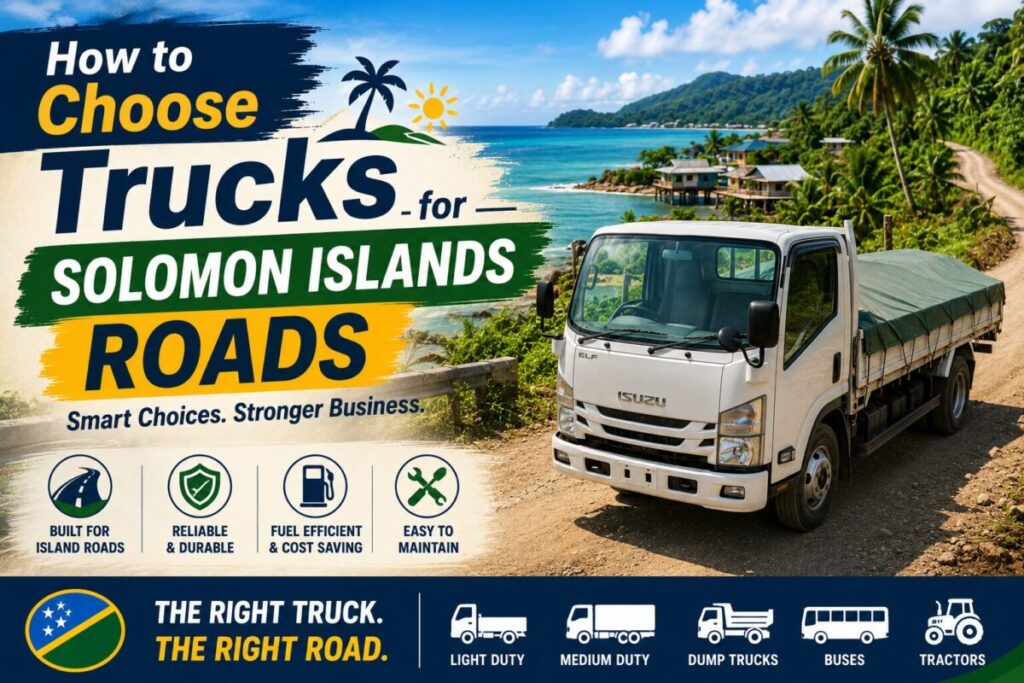

How to Choose the Best Trucks for Coastal and Rural Areas in Solomon Islands
Choosing a commercial truck in Solomon Islands requires careful planning.
A truck may work well in Honiara but struggle on a wet rural road.
Likewise, a strong rural truck may cost too much for short urban deliveries.
Therefore, buyers should match the vehicle to the actual route, cargo, and daily workload.
Coastal operations create another challenge.
Salt air, sea spray, humidity, and standing water can increase corrosion.
Meanwhile, rural routes may include gravel, mud, potholes, steep hills, and narrow bridges.
As a result, the cheapest truck may not provide the lowest long-term cost.
A reliable Japanese used truck can offer excellent value.
However, the correct model, drivetrain, body, payload, and condition remain essential.
This guide explains how Solomon Islands buyers can choose a suitable truck for coastal and rural work.
Why Truck Selection Matters in Solomon Islands
Commercial transport supports almost every major local industry.
Retailers need trucks to move imported goods from ports and warehouses.
Farmers need vehicles for cocoa, copra, vegetables, fruit, tools, and fertiliser.
Fishing businesses need transport for ice, fuel, nets, engines, and fresh products.
Furthermore, contractors need trucks for sand, gravel, timber, cement, steel, and equipment.
Hotels and resorts also need regular food, linen, furniture, and maintenance deliveries.
Therefore, truck downtime can quickly affect business income.
A suitable vehicle can reduce delays, fuel waste, repairs, and missed deliveries.
Understand Your Normal Operating Route
Before comparing trucks, study the route carefully.
Do not choose a vehicle only from photos or engine size.
Instead, record the surfaces and obstacles that the truck will face.
Questions to Ask About the Route
- Will the truck work mainly in Honiara?
- Will it travel on gravel or unsealed roads?
- Does the route become muddy after rain?
- Are there steep hills or sharp corners?
- Does the truck need to cross narrow bridges?
- Will it enter farms, plantations, or construction sites?
- Will it operate near beaches, ports, or wharves?
- Is enough turning space available at the destination?
- Can a recovery vehicle reach the route?
- Are repair workshops available nearby?
These answers help identify the right vehicle size and drivetrain.
Coastal Roads and Rural Roads Need Different Features
Trucks for Coastal Areas
Coastal trucks often face salt air and high humidity.
They may also enter ports, fish landing areas, beaches, and wharves.
Therefore, corrosion control should receive high priority.
A coastal truck should have a clean chassis and solid body mounts.
Brake lines, fuel lines, electrical connectors, and floor panels also need inspection.
In addition, operators need a regular washing and rust-prevention plan.
Trucks for Rural Areas
Rural trucks often face traction and clearance problems.
Mud, deep ruts, loose gravel, steep entrances, and soft shoulders can stop an unsuitable vehicle.
Therefore, buyers may need four-wheel drive, stronger tyres, or a shorter wheelbase.
A strong suspension also helps on uneven surfaces.
However, excessive vehicle size can create problems on narrow roads.
Consequently, compact strength often provides better value than maximum size.
Choose the Correct Truck Size
Truck size affects fuel use, payload, road access, and shipping cost.
Therefore, buyers should start with their normal cargo weight.
Mini Trucks
Japanese mini trucks suit light cargo and restricted spaces.
They can support farms, shops, resorts, schools, churches, and maintenance businesses.
They also use less fuel than larger commercial trucks.
However, their payload remains limited.
Therefore, they should not carry heavy cement, gravel, water tanks, or large timber loads.
Light-Duty Trucks
Light-duty trucks offer a strong balance for many Solomon Islands businesses.
They can carry more cargo than a mini truck.
However, they remain easier to drive than medium-duty vehicles.
They suit urban delivery, farm collection, construction support, and wholesale distribution.
Medium-Duty Trucks
Medium-duty trucks suit larger loads and more demanding commercial work.
They can transport construction materials, agricultural cargo, equipment, and bulk products.
Nevertheless, they need more road space and stronger bridges.
They also use more fuel and require larger tyres.
Heavy-Duty Trucks
Heavy-duty trucks suit major infrastructure and industrial work.
However, many village and coastal roads cannot support their full size.
Therefore, buyers should inspect every planned route before purchase.
Best Light-Duty Trucks for Mixed Island Work
1. Isuzu Elf
The Isuzu Elf is a practical light-duty truck for mixed commercial work.
Its compact cab helps on narrow streets and crowded loading areas.
Meanwhile, its diesel engine supports regular delivery and farm transport.
The Elf can suit:
- Retail delivery
- Farm produce collection
- Fishing supply transport
- Small construction work
- Hotel and restaurant supply
- General cargo movement
Four-wheel-drive versions may suit difficult rural routes.
However, buyers must confirm the exact drivetrain before purchase.
2. Hino Dutro
The Hino Dutro offers dependable light-duty commercial performance.
It works well for frequent delivery trips and municipal services.
Furthermore, its manageable size helps in Honiara traffic.
A Dutro can also support:
- Hardware suppliers
- Food distributors
- Maintenance companies
- Community projects
- Farm input delivery
- Small contractor operations
A box-body Dutro protects products from tropical rain.
Meanwhile, a flatbed provides flexible loading.
3. Mitsubishi Fuso Canter
The Mitsubishi Fuso Canter provides several body and drivetrain choices.
Therefore, it can serve both coastal and rural operators.
A standard flatbed suits farm and building materials.
A dump model supports smaller construction projects.
In addition, a box body protects packaged goods and food supplies.
The Canter can suit:
- Village distribution
- Construction support
- Agricultural collection
- Fishing businesses
- Utility maintenance
- Commercial delivery
4. Toyota Dyna
The Toyota Dyna offers simple and familiar commercial operation.
Many buyers value Toyota service knowledge and practical diesel performance.
Moreover, four-wheel-drive versions can support wet farm roads.
A shorter Dyna can also provide useful turning ability.
It may suit:
- Village shops
- Farm collection routes
- Tourism supply work
- Light construction
- Community transport support
- General delivery
Best Medium-Duty Trucks for Heavier Work
1. Hino Ranger
The Hino Ranger suits businesses that need greater carrying capacity.
It can support building suppliers, contractors, wholesalers, and agricultural buyers.
Furthermore, buyers can choose flatbed, dump, crane, box, or refrigerated bodies.
The Ranger works best where roads can support its loaded weight.
Therefore, route and bridge checks remain important.
2. Isuzu Forward
The Isuzu Forward provides practical medium-duty capacity.
It can reduce the number of trips needed for heavier cargo.
This may lower cost per delivered tonne.
However, operators must still avoid overloading.
The Forward can support:
- Construction materials
- Wholesale cargo
- Agricultural products
- Port logistics
- Refrigerated transport
- Water tanker operations
3. Mitsubishi Fuso Fighter
The Mitsubishi Fuso Fighter suits construction and regional transport.
It provides more payload than a light-duty truck.
Meanwhile, it remains more flexible than a heavy-duty model.
A Fighter dump truck can move sand, gravel, soil, and site waste.
A crane truck can support remote sites with limited lifting equipment.
When Should You Choose Four-Wheel Drive?
Four-wheel drive can improve traction on mud, gravel, grass, and soft ground.
Therefore, it can add value on rural and plantation routes.
However, 4WD also adds weight, maintenance parts, and purchase cost.
Consequently, not every business needs it.
Choose Four-Wheel Drive When:
- Roads become muddy during the wet season.
- The truck enters farms or plantations.
- The route includes steep gravel hills.
- The vehicle works on unfinished construction sites.
- The business serves remote communities.
- Two-wheel-drive vehicles often lose traction.
Choose Two-Wheel Drive When:
- The truck stays mainly on paved roads.
- The route remains flat and firm.
- Fuel economy has the highest priority.
- Local 4WD repair support remains limited.
- The truck performs urban delivery work.
Four-wheel drive does not increase the legal payload.
It also does not make deep floodwater safe.
Ground Clearance and Wheelbase
Ground clearance protects the truck on ruts and steep entrances.
However, a very high vehicle may feel less stable when overloaded.
Therefore, buyers need a balanced setup.
Wheelbase also affects performance.
A short wheelbase improves turning and breakover clearance.
Meanwhile, a longer wheelbase provides more body space.
However, long trucks may struggle on tight village corners.
Choose the Right Truck Body
Flatbed Trucks
Flatbeds offer flexible loading from the rear and sides.
They suit timber, pipes, produce, tanks, machinery, and building materials.
However, operators need covers for rain-sensitive cargo.
Drop-Side Trucks
Drop-side bodies make loading farm products and commercial goods easier.
They suit farms, markets, hardware stores, and general delivery.
Box Trucks
Box bodies protect cargo from rain, road dust, and theft.
They suit retail products, food, furniture, parcels, and hotel supplies.
However, the body weight reduces the remaining payload.
Dump Trucks
Dump trucks support construction, drainage, road repair, and land development.
They carry sand, gravel, soil, rocks, and waste.
However, dense materials can overload the vehicle quickly.
Crane Trucks
Crane trucks can lift cargo without separate machinery.
They suit utility work, construction, machinery delivery, and boat support.
Nevertheless, buyers must inspect the crane and hydraulic system.
Refrigerated Trucks
Refrigerated trucks support fisheries, hotels, restaurants, and food distributors.
They protect products during transport from landing points to markets.
However, refrigeration equipment needs specialist maintenance.
Water Tanker Trucks
Water trucks can support farms, construction sites, communities, and emergencies.
Buyers should check tank condition, pump operation, and legal payload.
Calculate the Correct Payload
Payload should guide every truck purchase.
Buyers should record their normal and maximum cargo weight.
They should also include tools, passengers, fuel, and body equipment.
Overloading can damage:
- Brakes
- Tyres
- Wheel bearings
- Springs
- Axles
- Transmission parts
- Chassis rails
- Steering components
Furthermore, an overloaded truck becomes harder to control on wet hills.
Therefore, a larger legal payload may provide better long-term value.
Tyre Choice for Coastal and Rural Routes
Tyres affect traction, braking, comfort, and fuel economy.
Therefore, they deserve careful attention.
Highway Tyres
Highway tyres suit paved roads and regular delivery routes.
They usually offer lower noise and better fuel economy.
All-Terrain Tyres
All-terrain tyres suit mixed paved, gravel, and farm-road use.
They can provide a useful balance for Solomon Islands operators.
Mud-Focused Tyres
Mud-focused tyres provide stronger grip on soft surfaces.
However, they can increase noise and fuel use.
Buyers should also confirm local replacement availability.
Important Tyre Checks
- Correct load rating
- Tread depth
- Tyre age
- Sidewall damage
- Uneven wear
- Matching axle sizes
- Spare tyre condition
- Local availability
Protecting a Truck from Coastal Corrosion
Salt air can damage a truck even without direct seawater contact.
Corrosion often begins under the vehicle.
Therefore, a clean exterior does not prove a clean chassis.
Inspect These Areas Before Buying
- Chassis rails
- Crossmembers
- Cab floor
- Door steps
- Wheel arches
- Brake lines
- Fuel lines
- Electrical earth points
- Body mounting brackets
- Battery area
Coastal Maintenance After Arrival
- Wash the underbody regularly.
- Remove salt and mud quickly.
- Repair paint damage early.
- Protect electrical terminals.
- Inspect brake pipes often.
- Apply suitable rust protection.
- Clean drainage holes.
- Store the truck under cover.
Maintenance Support in Rural Areas
A truck with advanced features may look attractive.
However, it can become costly when local support remains limited.
Therefore, rural buyers should prefer familiar and serviceable systems.
Before purchase, ask:
- Can local mechanics service the engine?
- Are oil and fuel filters available?
- Can replacement tyres be sourced?
- Are brake parts available?
- Can the transmission be repaired locally?
- Are diagnostic tools required?
- Can parts arrive quickly from overseas?
Simple maintenance access can reduce long periods of downtime.
Important Inspection Points Before Buying
Engine
Check the engine during a cold start.
Inspect smoke, noise, oil leaks, coolant leaks, and idle quality.
Also check the cooling system carefully.
Transmission and Clutch
Test every gear under normal driving conditions.
The clutch should not slip or produce strong vibration.
Automatic systems should shift smoothly.
Chassis
Check the chassis for rust, cracks, bending, and poor welding.
This step matters greatly for dump and crane trucks.
Brakes
Reliable brakes are essential on wet and steep roads.
Check warning lights, brake lines, drums, discs, and air equipment.
Suspension
Inspect springs, bushes, shock absorbers, mountings, and axles.
Rural roads can place high stress on these parts.
Four-Wheel Drive
Test 4WD engagement and warning lights.
Also inspect the transfer case, front axle, hubs, and drive shafts.
Commercial Body
Inspect the body as carefully as the engine.
Check floors, doors, hinges, locks, hydraulic equipment, and mounting points.
Fuel Economy and Total Business Cost
Fuel economy matters, but it should not guide the full decision.
A small truck may use less fuel per trip.
However, it may need several trips for one large load.
A medium-duty truck may use more fuel.
Nevertheless, it can reduce trip numbers and driver time.
Therefore, businesses should calculate cost per delivered tonne.
Include These Costs
- Purchase price
- Ocean freight
- Port charges
- Customs and registration
- Fuel
- Driver wages
- Tyres
- Routine servicing
- Repair parts
- Downtime
Plan for the Wet Season
Wet-season planning can prevent delivery failures.
Operators should inspect tyres, wipers, lights, brakes, and drainage systems early.
They should also carry useful emergency equipment.
- Recovery strap
- Rated shackles
- Strong jack
- Wheel chocks
- Shovel
- Tyre repair kit
- Air compressor
- Warning triangles
- First-aid kit
- Emergency drinking water
However, drivers should never enter unknown floodwater.
Four-wheel drive cannot protect an engine from deep water.
Import Planning for Solomon Islands
The purchase price represents only one part of the import budget.
Buyers should also plan freight, port handling, customs clearance, and local delivery.
Truck size and body type can affect the shipping method.
Therefore, buyers should request a complete landed-cost estimate.
Common Import Cost Areas
- Vehicle price
- Ocean freight
- Marine insurance when required
- Port handling
- Customs duties and taxes
- Broker charges
- Registration
- Local transport
- Initial servicing
- Replacement tyres or batteries
Import rules and charges may change.
Therefore, buyers should confirm the latest local requirements before shipment.
Why Buy a Japanese Used Truck?
Japan offers many commercial truck models and body types.
Buyers can compare year, mileage, payload, drivetrain, and vehicle condition.
Moreover, Japanese trucks often combine compact design with strong commercial ability.
This balance suits many Solomon Islands roads and businesses.
However, buyers should choose mechanical condition over fresh paint.
Detailed photos, specifications, and inspection information remain essential.
Why Choose EVERY TRADING?
EVERY TRADING has exported Japanese vehicles since 2006.
We have served customers in more than 100 countries.
Our team supports customers from vehicle selection through export preparation and shipment.
- Wide selection of Japanese used trucks
- Light, medium, and heavy-duty options
- Support for 4WD truck searches
- Detailed vehicle information
- Professional export documentation
- Worldwide shipping support
- Fast and clear communication
Furthermore, we understand that every island business has different transport needs.
A truck must match the road, cargo, body type, payload, and maintenance plan.
Therefore, customers should explain their operating conditions before choosing a vehicle.
Useful Information to Send EVERY TRADING
- Normal cargo type
- Expected cargo weight
- Road surface
- Coastal or inland operation
- Two-wheel drive or four-wheel drive
- Preferred body type
- Transmission preference
- Available budget
Final Truck Selection Checklist
- Match the payload to the normal cargo.
- Choose a body that protects or handles the cargo.
- Check road width and bridge limits.
- Select 4WD only when the route needs it.
- Confirm local tyre availability.
- Inspect the chassis for corrosion.
- Check engine and cooling performance.
- Confirm local maintenance support.
- Calculate the complete import cost.
- Plan preventive maintenance before arrival.
Final Thoughts
The best truck for Solomon Islands depends on the actual job.
Coastal operators need strong corrosion protection and regular washing.
Meanwhile, rural operators may need four-wheel drive, ground clearance, and durable tyres.
Light-duty trucks suit many farms, shops, fisheries, and delivery businesses.
Medium-duty trucks suit heavier construction and wholesale work.
However, every buyer should study payload, road access, fuel use, and maintenance support.
A carefully selected Japanese used truck can reduce downtime and delivery costs.
It can also provide reliable long-term support for business growth across Solomon Islands.


Browse Reliable Used Trucks & Buses from Japan
Carefully selected vehicles ready for export worldwide
Search 100,000+ Dealer Stock Vehicles from Japan
Access a wide selection of vehicles from Japanese dealers nationwide. Updated daily.
