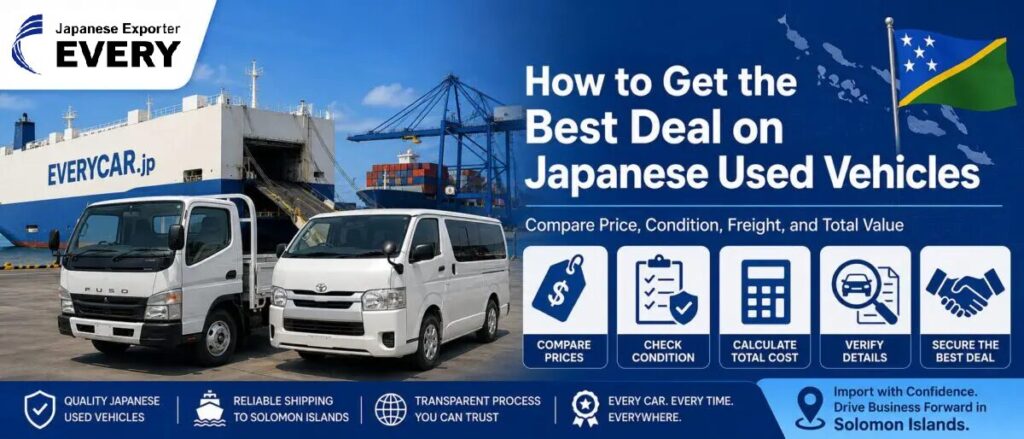

Finding a low-priced Japanese used vehicle is easy.
Finding the best overall deal requires more careful planning.
For Solomon Islands buyers, the cheapest vehicle can become the most expensive choice.
Freight, customs charges, port costs, repairs, fuel use, and island delivery can quickly change the final price.
Therefore, buyers should compare the complete landed cost.
They should also choose a vehicle that suits local roads, cargo, passengers, and available spare parts.
This guide explains how to secure real value from Japan.
It focuses on the needs of businesses, farmers, contractors, transport operators, schools, churches, and provincial buyers.
What Does the Best Vehicle Deal Really Mean?
The best deal is not always the lowest selling price.
Instead, it combines a fair price with reliable condition and suitable specifications.
A good deal should also offer reasonable freight and manageable ownership costs.
For example, one truck may cost less in Japan.
However, it may need new tyres, brake repairs, and suspension work after arrival.
Another truck may cost more at first.
Yet it may arrive ready for business.
Consequently, the second truck may deliver better value.
A strong vehicle deal should include:
- A suitable vehicle for the planned work
- A fair Japanese purchase price
- Clear inspection information
- Accurate freight charges
- Correct export documents
- Reasonable customs and clearance costs
- Available spare parts
- Practical fuel consumption
- Low risk of major repair
- Good resale potential
Start with the Job, Not the Vehicle
Many buyers start by searching for a popular model.
However, the work requirement should come first.
Ask what the vehicle must carry.
Then, consider the distance, road type, passenger count, and daily operating hours.
A delivery business in central Honiara needs a different vehicle from a logging support company.
Likewise, a school bus has different needs from a rural farm pickup.
Before searching, write down:
- Main purpose of the vehicle
- Expected cargo weight
- Number of passengers
- Daily travel distance
- Main operating area
- Road and bridge conditions
- Fuel budget
- Available mechanics
- Required body type
- Maximum purchase budget
This list prevents emotional buying.
It also helps the exporter recommend suitable stock.
Understand Solomon Islands Transport Conditions
Solomon Islands has a small road network spread across many islands.
Much of the network remains unsealed.
As a result, rain can create mud, potholes, erosion, and difficult access.
Vehicle conditions can also change quickly outside central Honiara.
Therefore, ground clearance and suspension strength matter.
Tyre size and replacement availability also matter.
In addition, many buyers must move vehicles beyond Guadalcanal.
This may require another coastal vessel or landing craft.
Consequently, vehicle size and weight affect provincial delivery costs.
A large truck may offer greater payload.
However, it may cost more to ship between islands.
It may also face problems at smaller wharves.
Choose the Correct Vehicle Category
Light Trucks for Honiara Businesses
Light-duty trucks often provide strong value for urban businesses.
They can carry food, hardware, furniture, water, parcels, and construction supplies.
A MITSUBISHI CANTER can suit delivery, trade, and small construction work.
A TOYOTA DYNA also offers practical urban cargo capacity.
Likewise, an ISUZU ELF can support daily commercial transport.
A HINO DUTRO may suit buyers who want a compact business truck.
These trucks often fit narrow streets better than larger models.
They also use less fuel during light work.
However, buyers must check the payload.
An overloaded light truck will wear quickly on rough roads.
Medium Trucks for Construction and Wholesale Work
Medium-duty trucks suit heavier cargo and longer commercial routes.
A HINO RANGER may support construction materials, machinery, and wholesale distribution.
An ISUZU FORWARD can also handle demanding business use.
Meanwhile, a MITSUBISHI FUSO FIGHTER may suit tipper, flatbed, and cargo body applications.
These vehicles can move more cargo per trip.
Therefore, they may reduce transport time.
Still, higher payload creates higher fuel and tyre costs.
Buyers should also confirm bridge access and turning space.
Vans for Staff, Cargo, and Service Businesses
Vans offer flexible value in Solomon Islands.
They can carry staff during the week and cargo when needed.
A TOYOTA HIACE VAN can suit hotels, churches, contractors, schools, and delivery businesses.
It can protect cargo from tropical rain.
It can also provide secure storage for tools and goods.
However, buyers should inspect the air-conditioning system.
They should also check sliding doors and rear door operation.
Buses for Schools, Churches, and Tourism
Passenger transport remains important across Guadalcanal and other provinces.
A TOYOTA COASTER may suit schools, churches, hotels, and tour companies.
A MITSUBISHI ROSA can support staff and community transport.
A NISSAN CIVILIAN offers another practical bus choice.
Before buying, confirm the number of seats.
Also, check seat belts, emergency exits, floor condition, and air conditioning.
A low-priced bus with a damaged interior may need expensive local work.
Pickups for Rural and Agricultural Work
Rural buyers often need higher ground clearance.
They may also need four-wheel drive.
A TOYOTA HILUX can suit farms, plantations, projects, and field teams.
A TOYOTA LAND CRUISER PICK UP may support heavier rural duties.
However, four-wheel drive does not remove every road problem.
Tyres, suspension, brakes, and driver skill remain important.
Set a Complete Landed-Cost Budget
Never use your full budget for the Japanese vehicle price.
The vehicle must still reach Solomon Islands.
It must then pass customs and port clearance.
A realistic budget should cover:
- Vehicle purchase price
- Japanese inland transport
- Export handling
- Inspection or additional checks
- Cleaning, when required
- Ocean freight
- Marine insurance
- Bank transfer charges
- Foreign exchange cost
- Customs duty and taxes
- Shipping agent fees
- Port charges
- Customs broker fees
- Storage, when applicable
- Registration
- Local delivery
- Provincial sea transport
- Initial maintenance
Next, add a reserve for unexpected costs.
A reserve of available working funds can prevent clearance delays.
It can also cover a battery, filter service, or minor repair.
Compare FOB, C&F, and CIF Prices Correctly
Vehicle prices can look similar while including different services.
Therefore, buyers must understand the shipping term.
FOB Price
FOB usually covers the vehicle and export handling in Japan.
The buyer arranges or pays the main ocean freight separately.
This option may suit experienced importers.
However, first-time buyers may find it more complex.
C&F Price
C&F usually includes the vehicle and ocean freight.
Marine insurance normally remains separate.
This structure makes price comparison easier for many buyers.
Still, destination charges are usually not included.
CIF Price
CIF usually includes the vehicle, freight, and marine insurance.
However, insurance policies can offer different protection.
Therefore, ask what the insurance covers.
Do not assume that it covers mechanical problems.
Compare Vehicles Using the Same Price Basis
A fair comparison needs the same terms.
Do not compare one FOB price with another C&F price.
Instead, request the same destination and shipping basis.
For each vehicle, compare:
- Vehicle price
- Freight
- Insurance
- Export charges
- Estimated customs value
- Expected destination costs
- Initial repair estimate
Then, calculate the likely landed cost.
This shows the real difference between vehicles.
Do Not Buy Based on Year Alone
A newer year can look attractive.
However, vehicle condition matters more than the registration year alone.
A newer truck may have high mileage and hard commercial use.
An older truck may have better maintenance and lower wear.
Therefore, check:
- Mileage
- Service records
- Body condition
- Chassis rust
- Engine condition
- Transmission operation
- Brake condition
- Tyres
- Suspension
- Previous body repairs
The best deal often comes from balanced condition.
It does not always come from the newest year.
Check Mileage in Context
Low mileage can increase the purchase price.
However, low mileage does not guarantee perfect condition.
A vehicle may have spent long periods without use.
This can affect seals, batteries, hoses, and tyres.
Meanwhile, a higher-mileage commercial vehicle may have received regular maintenance.
Therefore, compare mileage with service history and condition.
Also, consider the planned annual distance in Solomon Islands.
A local delivery truck may travel fewer kilometres than a long-route vehicle.
Ask for a Detailed Condition Check
A remote buyer cannot inspect the vehicle in person.
Therefore, photos and videos carry great value.
Ask for:
- Front, rear, and side photographs
- Cabin and seat photographs
- Dashboard and odometer photographs
- Engine bay photographs
- Chassis and underbody photographs
- Tyre photographs
- Cold-start video
- Engine-running video
- Driving video
- Body operation video
For a dump truck, request a video of the tipping body.
For a bus, request air-conditioning and door checks.
For a four-wheel-drive vehicle, request a 4WD operation check.
For a van, inspect the cargo floor and sliding doors.
Study the Chassis and Underbody
Solomon Islands roads can place heavy stress on a chassis.
Therefore, existing rust or damage needs careful attention.
Ask for clear underbody photographs.
Look for:
- Heavy rust
- Cracks
- Bent frame sections
- Oil leaks
- Damaged cross members
- Worn suspension mounts
- Poor welding repairs
Surface rust can be manageable.
However, structural corrosion can reduce vehicle life.
A cheap vehicle with major frame damage is rarely a good deal.
Inspect Tyres Before Comparing Prices
Tyres can create a large replacement cost.
This is especially important for trucks and buses.
A vehicle with six worn tyres may need immediate spending.
In addition, uncommon tyre sizes may cost more locally.
Check:
- Tread depth
- Sidewall cracks
- Uneven wear
- Tyre age
- Matching sizes
- Spare tyre condition
A slightly higher-priced vehicle with good tyres may offer better value.
Choose a Model with Available Spare Parts
Parts availability strongly affects long-term cost.
Popular Japanese trucks and vans often provide better parts access.
Local mechanics may also know these vehicles well.
Before buying, ask local workshops about:
- Oil filters
- Fuel filters
- Air filters
- Brake parts
- Clutch parts
- Suspension bushes
- Belts and hoses
- Electrical parts
- Body panels
A rare model may have a low purchase price.
However, one unavailable part can stop the vehicle for weeks.
Therefore, common models often provide better business value.
Consider Fuel Consumption Before Buying
Fuel creates a daily operating cost.
Therefore, a larger engine is not always better.
A Honiara delivery business may not need a medium-duty truck.
A light truck may carry the load with lower fuel use.
However, an undersized vehicle can also create problems.
It may require more trips or frequent overloading.
Choose enough engine power and payload for the work.
Then, avoid unnecessary size.
Match the Transmission to Local Use
Automatic transmission can make urban driving easier.
It may suit stop-and-start traffic around Honiara.
Manual transmission can offer simple operation and strong control.
It may also suit buyers with experienced commercial drivers.
However, clutch replacement can create a major cost.
Therefore, inspect manual clutch condition carefully.
For automatic vehicles, ask about shift quality and warning lights.
Select the Right Body Type
The truck body affects business value.
A low-priced chassis does not help when the body cannot perform the work.
Flatbed Trucks
Flatbeds suit timber, steel, building materials, and machinery.
They offer flexible loading.
However, cargo needs rain protection and secure tying.
Dump Trucks
Dump trucks suit gravel, soil, sand, and construction work.
Check the hydraulic system and body floor.
Also, inspect the subframe and tipping hinges.
Box Trucks
Box bodies protect food, furniture, cartons, and shop stock.
However, a tall box can increase freight dimensions.
It can also affect balance on rough roads.
Refrigerated Trucks
Refrigerated trucks can support fish, meat, and cold goods.
However, the refrigeration unit adds maintenance and fuel costs.
Confirm that local technicians can service the system.
Check Vehicle Dimensions Before Provincial Delivery
Vehicle dimensions affect ocean freight and local movement.
They also affect coastal shipping after Honiara.
A long bus or heavy truck may need special transport arrangements.
Some provincial wharves have limited equipment.
Therefore, confirm:
- Overall length
- Overall width
- Overall height
- Vehicle weight
- Turning radius
- Ground clearance
- Loading and unloading method
A smaller vehicle may cost less to move between islands.
It may also access narrow roads more easily.
Do Not Ignore Japanese Inland Transport
A vehicle may sit far from the export port.
Therefore, inland delivery can change the total price.
A cheap auction vehicle may need expensive transport across Japan.
Meanwhile, a slightly higher-priced vehicle near the port may cost less overall.
Ask whether the quotation includes:
- Auction collection
- Transport to the exporter’s yard
- Transport to the shipping port
- Temporary storage
- Port entry charges
Compare these costs before making a decision.
Compare Dealer Stock and Auction Stock
Dealer Stock
Dealer stock usually offers a fixed price.
It may also provide faster purchase decisions.
The exporter can often provide current photographs and videos.
This option may suit first-time buyers.
Auction Stock
Auction stock can offer a wider selection.
It may also provide access to lower purchase prices.
However, the final price can change through bidding.
Auction fees and inland transport also apply.
Moreover, the buyer must understand the auction sheet.
Therefore, auction stock does not always create the lowest landed cost.
Read Auction Information Carefully
Japanese auction sheets provide useful condition information.
They may show scratches, dents, rust, repairs, and interior wear.
However, buyers need a clear translation.
Do not focus only on the auction grade.
Also, check:
- Inspector comments
- Damage diagram
- Interior grade
- Mileage notes
- Rust comments
- Mechanical warnings
- Previous repair history
A low-grade work truck can still offer value.
However, the buyer must understand every defect.
Ask for More Than One Vehicle Option
Do not make a decision after seeing one unit.
Ask the exporter to provide several suitable options.
Then, compare them using the same checklist.
For example, compare three light trucks by:
- Year
- Mileage
- Payload
- Tyre condition
- Body type
- Freight
- Repair needs
- Total landed estimate
This approach improves negotiating power.
It also reduces the risk of buying the wrong unit.
Negotiate the Complete Package
Price negotiation does not need to focus only on the vehicle.
You can also discuss the complete export package.
Ask whether the exporter can include:
- Additional inspection photos
- Oil and filter service
- Battery testing
- Spare key
- Basic cleaning
- Replacement wiper blades
- Minor light repairs
- Secure spare-part loading
These small items may offer more value than a small discount.
However, confirm every agreement in writing.
Do Not Chase an Unrealistic Discount
A genuine exporter must cover the vehicle and export costs.
Therefore, an extreme discount may indicate a problem.
The vehicle may have hidden damage.
The seller may also exclude freight or other charges.
In the worst case, the offer may be fraudulent.
Compare the price with similar vehicles.
Then, ask why the unit costs much less.
A trustworthy seller should provide a clear answer.
Verify the Exporter Before Paying
A good vehicle deal requires a genuine exporter.
Check:
- Official company name
- Japanese office address
- Official website
- Company email address
- Telephone number
- Vehicle stock page
- Customer delivery records
- Export experience
- Company bank beneficiary
Do not send money to an unknown personal account.
Also, verify any sudden bank detail change.
A low price cannot protect the buyer from payment fraud.
Check the Proforma Invoice
The invoice should match the selected vehicle.
Review:
- Exporter’s company name
- Buyer’s name
- Vehicle make and model
- Chassis number
- Stock number
- Vehicle price
- Freight amount
- Shipping term
- Destination port
- Total amount
- Payment currency
- Bank beneficiary
One incorrect chassis character can cause a serious problem.
Therefore, compare the invoice with vehicle photos and documents.
Prepare for Customs Before Shipment
Do not wait until the vehicle arrives.
Contact a Solomon Islands customs broker before shipment.
Provide the vehicle details and quotation.
Ask for an estimated customs and clearance budget.
Customs makes the final assessment.
However, an early estimate supports better planning.
Keep the following records:
- Proforma invoice
- Commercial invoice
- Payment receipt
- Export certificate
- Bill of lading
- Freight details
- Insurance document
Never request a false low invoice.
Incorrect values can cause delays, penalties, or reassessment.
Plan for Port and Shipping Agent Charges
Ocean freight does not cover every arrival cost.
The buyer may also pay:
- Shipping agent fee
- Delivery order fee
- Port handling
- Wharf charges
- Customs broker fee
- Storage charges
- Inspection costs
Ask the local shipping agent for an estimate.
Then, prepare the funds before the vessel arrives.
Late clearance can create extra storage costs.
Plan Provincial Delivery Before Buying
Many buyers live outside Honiara.
Therefore, the vehicle may need onward sea transport.
Arrange this before shipment from Japan.
Ask:
- Which vessel can carry the vehicle?
- What is the maximum size?
- How will the vehicle enter the vessel?
- How will it leave at the destination?
- Does the wharf have a ramp?
- Is lifting equipment available?
- What are the local port charges?
This information may change the best vehicle choice.
A smaller truck can sometimes provide a lower total cost.
Consider the Rainy Season
Heavy rain can disrupt roads and local delivery.
It may also delay construction and farming work.
Therefore, buyers should plan arrival timing carefully.
A vehicle arriving during difficult weather may remain near the port.
Provincial transport may also face delays.
Allow extra time in the business plan.
Calculate Expected Income from the Vehicle
A commercial vehicle should support income or reduce costs.
Therefore, calculate its expected return.
For a truck, estimate:
- Average income per trip
- Trips per week
- Fuel cost per trip
- Driver cost
- Maintenance reserve
- Insurance and registration
- Loan payments, when applicable
For a bus, estimate passenger income and occupancy.
For a company van, calculate savings from reduced hired transport.
A low-priced vehicle is not a good deal when it cannot earn enough.
Keep a Maintenance Reserve
Every used vehicle needs maintenance.
Therefore, keep part of the budget after purchase.
The first service may include:
- Engine oil
- Oil filter
- Fuel filter
- Air filter
- Coolant
- Brake inspection
- Battery check
- Tyre pressure
- Greasing
- Belt and hose inspection
This service creates a reliable starting point.
It can also prevent costly breakdowns.
Use a Vehicle Comparison Checklist
Before choosing, score each vehicle in the same way.
- Suitability for the planned work
- Purchase price
- Freight cost
- Mileage
- Engine condition
- Transmission condition
- Tyre condition
- Chassis condition
- Parts availability
- Fuel consumption
- Local delivery cost
- Expected repair cost
- Expected resale value
The highest-scoring vehicle may not have the lowest Japanese price.
However, it may offer the best long-term value.
Common Mistakes That Destroy a Good Deal
- Buying only because the price looks low
- Ignoring freight and destination charges
- Choosing the wrong payload
- Buying a vehicle that is too large
- Ignoring tyre condition
- Skipping a cold-start video
- Failing to inspect the chassis
- Choosing a rare model with limited parts
- Using the full budget before customs clearance
- Forgetting provincial delivery
- Paying an unverified bank account
- Requesting a false customs invoice
Best Deal Strategy for First-Time Buyers
First-time buyers should keep the process simple.
Start with a common Japanese model.
Choose a vehicle that local mechanics understand.
Ask for a fixed C&F or CIF quotation.
Then, request detailed photos and videos.
Next, obtain a customs estimate.
Finally, prepare all arrival funds before payment.
This approach may not find the absolute lowest price.
However, it reduces expensive surprises.
Best Deal Strategy for Business Buyers
Business buyers should focus on productivity.
Calculate payload, daily trips, fuel use, and expected income.
Compare several units.
Also, consider buying common models across the fleet.
A standard fleet can simplify parts and maintenance.
It can also reduce driver training time.
Best Deal Strategy for Provincial Buyers
Provincial buyers should begin with the final delivery route.
Confirm vessel access and wharf facilities.
Then, choose a vehicle that fits those limits.
Prioritise ground clearance, strong suspension, and common tyres.
Also, keep spare filters and service parts inside the vehicle when shipping rules allow.
Questions to Ask Before Confirming the Deal
- Does this vehicle suit my cargo or passengers?
- What is the legal payload?
- Does the engine start from cold?
- Are there warning lights?
- Does the transmission operate smoothly?
- Are there oil or coolant leaks?
- What condition are the tyres in?
- Is there structural rust?
- Does the price include inland transport?
- Does the price include ocean freight?
- What charges remain in Solomon Islands?
- Can I get the full chassis number?
- Which documents will the exporter provide?
- Are common parts available locally?
- How will I transport it after Honiara?
Final Advice for Solomon Islands Buyers
The best Japanese used vehicle deal is not simply the lowest advertised price.
It is the vehicle that completes the required work at a manageable total cost.
Therefore, compare condition, freight, customs, fuel use, parts, and delivery.
Choose a size that suits local roads and wharves.
Also, inspect the engine, tyres, chassis, transmission, and body equipment.
Work with a verified Japanese exporter.
Use correct invoices and prepare clearance funds early.
Most importantly, think beyond the purchase day.
A dependable vehicle can support a Solomon Islands business for many years.
With careful comparison, buyers can secure strong value and avoid costly mistakes.


Browse Reliable Used Trucks & Buses from Japan
Carefully selected vehicles ready for export worldwide
Search 100,000+ Dealer Stock Vehicles from Japan
Access a wide selection of vehicles from Japanese dealers nationwide. Updated daily.
