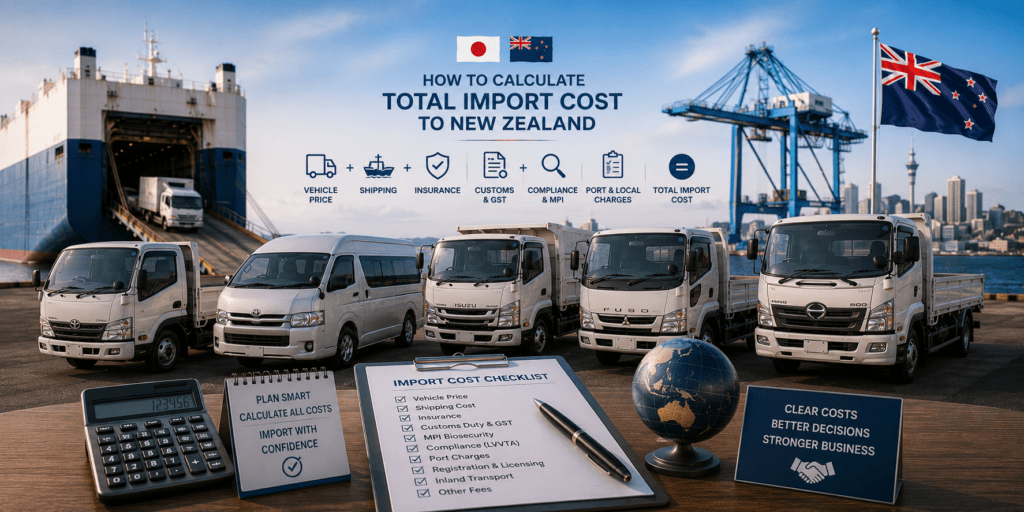

How to Calculate Total Import Cost to New Zealand: A Complete Guide for Japanese Used Vehicle Buyers
Know the Full Cost Before You Import from Japan
Importing a Japanese used vehicle to New Zealand can be a smart business decision.
Japanese trucks, vans, buses, tractors, and commercial vehicles are trusted for quality, reliability, and long service life. They support many New Zealand industries, including construction, farming, delivery, forestry, tourism, and local services.
However, the vehicle price is not the total cost.
Before you buy, you must calculate every cost from Japan to New Zealand. This includes the vehicle price, shipping, insurance, GST, port charges, compliance, biosecurity, registration, and local transport.
Therefore, understanding the total import cost helps you avoid surprises.
It also helps you compare vehicles more accurately.
Why Total Import Cost Matters
Many buyers only compare the vehicle price.
However, this can create mistakes.
A cheaper truck may have higher shipping costs.
A larger vehicle may need more compliance work.
A poorly cleaned vehicle may cause biosecurity delays.
As a result, the lowest advertised price may not become the best deal.
Smart New Zealand buyers always calculate the landed cost first.
What Is Total Import Cost?
Total import cost means the full amount needed to bring the vehicle from Japan to New Zealand and prepare it for use.
It may include:
- Vehicle price
- Export service cost
- Ocean freight
- Marine insurance
- GST
- Customs clearance
- Port handling
- MPI biosecurity inspection
- Cleaning or treatment costs
- Compliance inspection
- Registration
- Inland delivery
- Bank transfer fees
- Exchange rate difference
Once you add these costs, you can see the real price.
Step 1: Start with the Vehicle Price
The first cost is the vehicle price in Japan.
This price depends on:
- Make
- Model
- Year
- Mileage
- Condition
- Body type
- Engine type
- Auction grade
- Demand
For example, an Isuzu Elf usually costs less than a Hino Ranger.
Also, a simple flatbed truck costs less than a crane truck or refrigerated truck.
Therefore, choose the vehicle based on your business needs.
Step 2: Add Shipping Cost
Shipping is one of the biggest import costs.
Japan has strong shipping routes to New Zealand.
However, the cost depends on vehicle size and shipping method.
Common shipping methods include:
RORO Shipping
RORO means Roll-On/Roll-Off.
The vehicle drives onto the ship.
This method often works well for running trucks, vans, buses, and passenger vehicles.
Container Shipping
Container shipping offers more protection.
It may suit smaller vehicles, parts, or special cargo.
However, large trucks may not fit inside a standard container.
Step 3: Add Marine Insurance
Marine insurance protects your investment during ocean transport.
It may cover damage or loss during shipment.
The cost is usually small compared with the value of the vehicle.
Therefore, many business buyers choose insurance for peace of mind.
Step 4: Calculate GST
New Zealand applies GST to imported goods.
For vehicle imports, buyers should confirm the latest tax calculation with New Zealand Customs or a customs broker.
GST can apply to the vehicle value and related import costs.
Because this amount affects your total budget, calculate it before payment.
Step 5: Add Customs Clearance Costs
Customs clearance is required after arrival.
A customs broker can help with:
- Import entry
- Documentation
- GST calculation
- Customs communication
- Release procedures
Broker fees vary.
However, professional support can reduce delays and paperwork mistakes.
Step 6: Add Port Charges
After the vehicle arrives, port charges apply.
These may include:
- Terminal handling
- Storage
- Documentation
- Wharf charges
- Release fees
Storage fees can increase if documents are late.
Therefore, prepare all paperwork early.
Step 7: Add MPI Biosecurity Costs
New Zealand has strict biosecurity rules.
Used vehicles and machinery can carry soil, seeds, insects, plant matter, or pests.
Because of this, imported vehicles must meet cleanliness requirements.
If the vehicle fails inspection, extra cleaning or treatment may be required.
This can increase your total cost.
Therefore, buying from an exporter who understands New Zealand import rules is very important.
Step 8: Add Compliance and Entry Certification
Before road use, many imported vehicles must meet New Zealand standards.
Compliance checks may include:
- Safety standards
- Emissions standards
- Lighting
- Brakes
- Structural condition
- Seat belts
- Vehicle identity
- Previous damage checks
If the vehicle does not meet requirements, repair costs can increase.
Therefore, check compliance before shipping.
Step 9: Add Registration and Licensing
After compliance, the vehicle may need registration.
This allows legal road use in New Zealand.
Registration costs depend on vehicle type and usage.
Commercial trucks may also require additional checks.
Always confirm requirements before importing.
Step 10: Add Inland Transport
Your vehicle may arrive at a port such as Auckland, Tauranga, Wellington, Lyttelton, or another destination.
After clearance, you may need delivery to your yard, farm, workshop, or business location.
Inland transport cost depends on:
- Distance
- Vehicle size
- Vehicle condition
- Delivery method
A running vehicle may cost less to move.
A non-running vehicle may need special transport.
Step 11: Add Bank Fees and Exchange Rate Costs
Japanese exporters often quote in Japanese Yen or US Dollars.
Your bank may charge:
- International transfer fee
- Currency conversion fee
- Receiving bank fee
- Exchange rate margin
Exchange rates also change daily.
Therefore, always confirm the final payment amount before sending money.
Simple Total Cost Formula
You can use this simple formula:
Vehicle Price
- Shipping
- Insurance
- GST
- Customs Broker Fee
- Port Charges
- Biosecurity Costs
- Compliance Costs
- Registration
- Inland Transport
- Bank Fees
= Total Import Cost
This formula helps you compare different vehicles fairly.
Example Cost Breakdown
Here is a simple example.
Vehicle:
Japanese used light truck
Estimated costs:
- Vehicle price: USD 10,000
- Shipping: USD 2,000
- Insurance: USD 150
- Port and clearance: varies
- GST: depends on customs calculation
- Compliance: varies
- Inland transport: varies
- Bank fees: varies
This example shows why buyers should never look only at the vehicle price.
The final cost depends on several items.
Why New Zealand Buyers Import Japanese Used Commercial Vehicles
New Zealand businesses need reliable vehicles for daily work.
Japanese commercial vehicles are popular because they offer:
- Strong diesel engines
- Excellent fuel economy
- Long service life
- Good resale value
- Easy operation
- Quality manufacturing
- Wide model selection
These benefits matter across many sectors.
Best Vehicles for New Zealand Businesses
Construction
Popular choices include:
Delivery and Logistics
Common choices include:
Agriculture
Farmers often choose:
- Hino Dutro
- Toyota Dyna
- Isuzu Elf
- Japanese used tractors
Forestry and Heavy Transport
Heavy-duty buyers may consider:
Road Conditions in New Zealand
New Zealand has many different driving environments.
These include:
- City roads
- Rural roads
- Mountain highways
- Coastal routes
- Farm access roads
- Construction sites
Therefore, buyers should choose the right truck size and engine power.
A compact truck works well in city delivery.
A stronger truck suits construction and rural use.
Common Mistakes to Avoid
Looking Only at FOB Price
FOB price does not include all costs.
Always calculate the full landed cost.
Ignoring Compliance
A vehicle that cannot meet New Zealand standards may become expensive.
Check before buying.
Forgetting Biosecurity
Cleaning problems can create extra costs.
Choose exporters who understand MPI requirements.
Not Checking Exchange Rates
Currency movement affects the final payment amount.
Choosing the Wrong Truck
A truck that is too small or too large can reduce business efficiency.
How to Reduce Total Import Cost
You can reduce costs with smart planning.
First, choose the correct vehicle size.
Next, compare shipping options.
Also, check compliance before purchase.
Then, confirm biosecurity preparation.
Finally, work with an experienced exporter.
These steps help prevent expensive surprises.
Why Transparent Quotations Matter
A good quotation should clearly show:
- Vehicle price
- Shipping term
- Destination port
- Payment currency
- Included services
- Excluded local costs
This helps buyers plan with confidence.
It also makes vehicle comparison easier.
Why Choose EVERY TRADING Co., Ltd.
EVERY TRADING Co., Ltd. has exported Japanese used vehicles since 2006.
We support buyers in more than 100 countries.
For New Zealand customers, we provide:
- Clear quotations
- Quality vehicle information
- Export support
- Shipping arrangement
- Secure payment guidance
- Professional documentation
- Friendly customer service
We help buyers understand the full cost before purchase.
Frequently Asked Questions
Is the vehicle price the same as total import cost?
No.
The total cost includes shipping, GST, port charges, compliance, biosecurity, and other fees.
Is Japan a good source for used trucks?
Yes.
Japan offers reliable commercial vehicles with strong engines and good maintenance history.
Can I reduce import costs?
Yes.
Choose the right vehicle, plan early, compare shipping, and confirm compliance before shipment.
Should I use a customs broker?
Many buyers use one.
A broker can help reduce paperwork errors and clearance delays.
Final Thoughts
Calculating total import cost is essential for New Zealand buyers.
A Japanese used truck, van, bus, tractor, or commercial vehicle can offer excellent value.
However, the smartest buyers look beyond the vehicle price.
They calculate shipping, insurance, GST, port charges, biosecurity, compliance, registration, inland transport, and bank fees.
By understanding the full cost before buying, you can make a safer and more profitable decision.
At EVERY TRADING Co., Ltd., we help New Zealand buyers import reliable Japanese used vehicles with clear information, transparent pricing, and professional export support.
When you calculate the total cost correctly, you can buy with confidence and build a stronger business.


Browse Reliable Used Trucks & Buses from Japan
Carefully selected vehicles ready for export worldwide
Search 100,000+ Dealer Stock Vehicles from Japan
Access a wide selection of vehicles from Japanese dealers nationwide. Updated daily.
