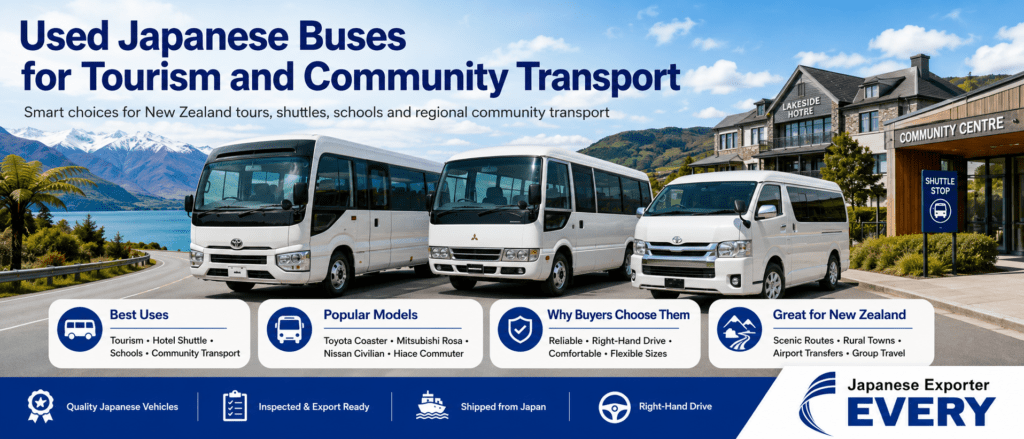

Best Japanese Used Buses for NZ Tourism and Community Transport
New Zealand needs reliable buses.
Tour companies need them.
Hotels need them.
Schools need them.
Community groups need them.
Also, rural towns need better transport options.
That is why Japanese used buses can be a smart choice.
New Zealand has a unique transport market. The country has busy cities, famous tourist routes, small towns, rural communities, mountain roads, coastal roads, and remote regions.
Because of this, one bus type cannot fit every job.
A tour company in Queenstown may need a comfortable coach.
A hotel in Auckland may need a shuttle bus.
A school group may need a safe mid-size bus.
A rural community may need a small people mover or minibus.
A tourism operator may need a bus with good luggage space.
Japanese used buses offer many choices. They are right-hand drive, practical, and often well maintained. Also, many Japanese models fit New Zealand roads very well.
New Zealand’s tourism demand also continues to recover. Stats NZ reported that visitor arrivals reached 358,900 in March 2026, up 15 percent from March 2025. This matters for tour operators, shuttle companies, hotels, and local travel services.
So, now is a good time to think about transport capacity.
Why Japanese Used Buses Fit New Zealand
Japan and New Zealand both use right-hand-drive vehicles.
This is a major advantage. Drivers sit on the correct side for New Zealand roads. Also, many Japanese buses have layouts that feel natural for local operation.
Japanese buses also come in many sizes.
Buyers can find:
- Small shuttle buses
- Microbuses
- School-style buses
- Mid-size buses
- Large coaches
- Wheelchair-accessible buses
- Hotel transfer buses
- Tourist buses
- Community transport buses
As a result, buyers can choose a bus that fits the route and passenger group.
New Zealand also has clear import rules. NZTA explains that used vehicles from Japan need evidence that they meet approved standards before registration for road use.
Therefore, buyers should choose carefully.
A good bus is not only cheap. It must match New Zealand use, passenger needs, road conditions, and compliance requirements.
New Zealand Tourism Creates Real Bus Demand
Tourism is very important for New Zealand.
Visitors travel between airports, hotels, ski fields, national parks, city attractions, cruise ports, wineries, adventure tours, and scenic routes.
Many of these trips need group transport.
For example, buses can support:
- Airport transfers
- Hotel shuttles
- Sightseeing tours
- Ski field transport
- Cruise passenger transfers
- School trips
- Sports team travel
- Winery tours
- Outdoor activity tours
- Community event transport
Also, many tourists do not want to drive on unfamiliar roads. Some routes include hills, narrow roads, weather changes, and long distances.
Therefore, a comfortable bus service can add value.
It can also improve safety and convenience.
For tour operators, the right Japanese used bus can become a strong business asset.
Community Transport Needs in Rural New Zealand
New Zealand has many rural communities.
Some people live far from major public transport routes. Seniors, students, workers, medical patients, and people without cars may need local transport support.
Research from NZTA has discussed poor access to land transport in rural New Zealand and its social impacts. This shows why local mobility matters outside large urban areas.
For community groups, a used Japanese bus can support practical services.
It can help with:
- Medical appointment transport
- Community centre trips
- School activity transport
- Sports club travel
- Church group travel
- Senior transport
- Local event shuttles
- Rural town connections
A small bus or microbus can be more practical than a large coach.
It costs less to run. It also fits narrow roads, small parking areas, and lower passenger numbers.
So, Japanese microbuses are attractive for community use.
Best Japanese Used Buses for New Zealand
1. Toyota Coaster
The Toyota Coaster is one of the most popular Japanese used buses.
It is known worldwide. It is also practical, simple, and easy to drive compared with large coaches.
For New Zealand, the Coaster fits many needs.
It can work for tourism, airport transfers, school groups, churches, sports clubs, community groups, and hotel shuttles.
The size is a major benefit.
A Coaster is larger than a van. However, it is smaller than a full-size coach. This makes it useful for narrow roads, small towns, and local shuttle routes.
Good uses include:
- Hotel shuttle service
- Airport transfer
- Winery tour
- Small sightseeing tour
- School activity transport
- Community group travel
- Ski accommodation transfer
- Regional event shuttle
The Toyota brand also gives confidence.
Many New Zealand buyers know Toyota. This can help with trust and resale appeal.
Best for New Zealand:
Tourism, hotels, schools, clubs, small groups, and community transport.
2. Nissan Civilian
The Nissan Civilian is another strong microbus option from Japan.
It has a practical size and simple layout. It can carry groups without feeling too large.
For New Zealand, the Civilian can suit local operators who need an affordable people mover.
It works well for:
- Tour operators
- Schools
- Sports groups
- Church groups
- Rural communities
- Shuttle companies
- Worker transport
- Small regional routes
A Civilian can be a good choice for buyers who want value.
It may cost less than some Toyota Coaster models. However, condition matters.
Buyers should check engine condition, rust, interior wear, air conditioning, seats, doors, and documents.
If the bus is clean, a Nissan Civilian can provide strong daily service.
Best for New Zealand:
Budget-focused buyers, local shuttle routes, school groups, sports groups, and community use.
3. Mitsubishi Rosa
The Mitsubishi Rosa is a well-known Japanese microbus.
It is popular in many export markets because it is practical and strong.
For New Zealand, the Rosa can fit both tourism and community needs.
It is useful for:
- Airport transfers
- Hotel shuttles
- Small tour groups
- Regional community transport
- Worker transport
- School trips
- Club travel
The Rosa often has comfortable seating and useful passenger capacity. Some models also have luggage space, depending on layout.
This helps tourism operators.
For example, a small tour company may use a Rosa for scenic day trips. A lodge may use it for guest transfers. A rural community group may use it for weekly transport services.
The Rosa gives a good balance of size, comfort, and cost.
Best for New Zealand:
Small tourism, lodge transfers, local shuttle work, schools, and community groups.
4. Hino Liesse
The Hino Liesse is a useful small to mid-size Japanese bus.
It often fits operators who need more comfort than a basic shuttle but do not need a full-size coach.
For New Zealand, this can be attractive.
The Liesse can support:
- Regional sightseeing
- School trips
- Rural route service
- Community transport
- Staff transport
- Event shuttles
- Small charter service
Hino has a strong commercial vehicle image. Many buyers trust the brand for durability and practical engineering.
The Liesse can also feel stable on longer routes.
This matters for New Zealand tourism, where trips can include highways, hills, and winding roads.
Buyers should check air conditioning, suspension, seat layout, luggage needs, and compliance.
Best for New Zealand:
Regional tours, charter work, school groups, and community passenger transport.
5. Hino Rainbow
The Hino Rainbow is a larger bus option.
It can suit buyers who need more passenger capacity than a microbus.
For New Zealand, the Rainbow can work well for school transport, larger community groups, staff movement, and regional charter.
It may also suit tour companies that run bigger group trips.
Good uses include:
- School transport
- Large club trips
- Regional charters
- Staff shuttles
- Community routes
- Event transport
- Sightseeing groups
The Rainbow can carry more people. However, it also needs more space, more fuel, and the right driver licence.
Therefore, buyers should think carefully about route size and passenger numbers.
If the business has steady demand, a Rainbow can be useful.
Best for New Zealand:
Schools, larger groups, regional charters, event transport, and community service.
6. Isuzu Journey
The Isuzu Journey is another practical Japanese bus.
It can suit community use, school groups, worker transport, and small tourism businesses.
Isuzu has a strong name in New Zealand’s commercial vehicle market. That can help buyers feel more confident.
The Journey often appeals to practical operators.
It can support:
- Local shuttle routes
- Rural community transport
- School activities
- Worker transport
- Small tours
- Church and club trips
The Journey is not always as famous as the Toyota Coaster. However, it can offer good value when the condition is strong.
Buyers should compare seating, mileage, rust, engine sound, and parts availability.
Best for New Zealand:
Community transport, school groups, worker transport, rural service, and small tours.
7. Toyota Hiace Commuter
The Toyota Hiace Commuter is smaller than a microbus.
However, it is very useful for New Zealand operators who need flexible transport.
It works well for:
- Airport shuttle
- Hotel transfer
- Small tour groups
- Medical transport
- Staff movement
- School support
- Lodge guest transfers
- Community group transport
The Hiace is easier to park than a bus. It also suits narrow roads and small towns.
For small tourism operators, this matters.
A Hiace Commuter can work well when passenger numbers stay low. It can also support premium private tours.
Because Toyota has strong trust in New Zealand, resale appeal can also be good.
Best for New Zealand:
Small shuttles, hotels, private tours, staff transport, and flexible community service.
8. Mitsubishi Fuso Aero Midi
The Mitsubishi Fuso Aero Midi can suit buyers who need a mid-size bus.
It can work for route service, tourism, charter, and larger community groups.
For New Zealand, this type of bus can support higher passenger numbers while staying smaller than a large coach.
Good uses include:
- Regional route service
- Medium-size tours
- School transport
- Worker transport
- Event shuttles
- Community charters
The Aero Midi can be useful in areas where a microbus is too small but a full coach is too large.
However, buyers should check parts support, age, emissions evidence, and overall condition.
A mid-size bus can be very practical, but compliance must come first.
Best for New Zealand:
Regional passenger routes, medium tours, school transport, and staff shuttles.
Best Bus Types for New Zealand Buyers
Microbuses
Microbuses are very practical.
They work well for tourism, schools, clubs, hotels, and community groups.
Popular models include:
- Toyota Coaster
- Nissan Civilian
- Mitsubishi Rosa
- Isuzu Journey
Microbuses suit New Zealand because they balance passenger capacity and road usability.
They can enter smaller roads, hotel entrances, rural properties, and local parking areas more easily than large coaches.
Mid-Size Buses
Mid-size buses suit larger groups.
They can work for schools, charters, regional routes, and staff transport.
Popular models include:
- Hino Liesse
- Hino Rainbow
- Mitsubishi Fuso Aero Midi
They offer more passenger space. However, they need more careful route planning.
They also require stronger compliance checks.
Large Coaches
Large coaches suit major tourism and long-distance travel.
They can work for:
- Large sightseeing groups
- Cruise passenger tours
- Intercity charter
- Ski travel
- Big school trips
- Event transport
However, they need proper operating space.
New Zealand roads can include narrow sections, hills, and winding routes. Therefore, large coaches need experienced drivers and suitable routes.
Commuter Vans
Commuter vans are best for small groups.
The Toyota Hiace Commuter is a strong example.
These vehicles suit small tours, hotel transfers, medical transport, and staff movement.
They are easier to manage than a bus. However, they carry fewer passengers.
For many small operators, this can be a perfect starting point.
Which Bus Fits Each New Zealand Business?
For Tourism Operators
Best choices:
- Toyota Coaster
- Mitsubishi Rosa
- Hino Liesse
- Hino Rainbow
- Toyota Hiace Commuter
Tourism operators should think about passenger comfort.
Important features include:
- Air conditioning
- Seat condition
- Luggage room
- Large windows
- Ride comfort
- Door operation
- Clean interior
New Zealand tours often involve long scenic routes. So, comfort matters.
For Hotels and Lodges
Best choices:
- Toyota Hiace Commuter
- Toyota Coaster
- Mitsubishi Rosa
- Nissan Civilian
Hotels and lodges need easy guest transport.
Good uses include:
- Airport pickup
- Station transfer
- Ski field transfer
- Local sightseeing
- Event transport
- Group check-in transfer
A smaller bus often works better than a large coach.
It is easier to park and easier to schedule.
For Community Groups
Best choices:
- Toyota Coaster
- Nissan Civilian
- Mitsubishi Rosa
- Isuzu Journey
- Toyota Hiace Commuter
Community groups need affordable and reliable transport.
They may carry seniors, students, sports teams, church members, or local volunteers.
A used Japanese microbus can offer good value.
However, easy entry and seat layout are important.
Some groups may also need wheelchair access.
For Schools and Clubs
Best choices:
- Toyota Coaster
- Mitsubishi Rosa
- Hino Rainbow
- Isuzu Journey
Schools and clubs often need safe group transport.
They may travel to sports games, camps, field trips, events, or regional competitions.
Important checks include:
- Seat belts
- Seat condition
- Door safety
- Emergency exits
- Air conditioning
- Driver visibility
- Compliance documents
Safety must come before price.
For Rural and Regional Routes
Best choices:
- Toyota Coaster
- Nissan Civilian
- Mitsubishi Rosa
- Hino Liesse
Rural routes may have fewer passengers. They may also include narrow roads and long distances.
A microbus can be better than a large bus in these areas.
It can reduce fuel cost and improve route flexibility.
This is useful for community transport and local shuttle services.
What New Zealand Buyers Should Check Before Buying
1. Import Eligibility
Before buying a used Japanese bus, confirm import eligibility.
NZTA explains that imported vehicles need to meet safety and emissions standards. They also need border inspection, entry certification, registration, and licensing before road use.
This is very important for buses.
Passenger vehicles may need specific standards and evidence. So, buyers should talk with an entry certifier before purchase.
2. Seating Capacity and Layout
Seat count matters.
However, layout also matters.
Check:
- Seat number
- Seat spacing
- Aisle width
- Door position
- Luggage space
- Seat belts
- Emergency exits
- Accessibility needs
A bus with many seats may not suit tourism if luggage space is poor.
Likewise, a community bus may need easier access, not maximum seating.
3. Engine and Transmission
A bus must drive smoothly.
New Zealand routes can include hills, long roads, and stop-start city traffic.
Check:
- Engine start
- Idle sound
- Transmission shift
- Warning lights
- Exhaust smoke
- Cooling system
- Brake condition
- Suspension
A short video can help buyers understand the condition.
4. Chassis Rust
Rust is important.
Many buses in Japan work in cities or near coastal areas. New Zealand also has coastal conditions.
Ask for underbody photos.
Check:
- Chassis rails
- Floor underside
- Step area
- Door area
- Wheel arches
- Suspension mounts
- Rear frame
- Battery area
Hidden rust can create large repair costs.
5. Interior Condition
Bus interiors matter more than truck interiors.
Passengers notice the seats, windows, roof, lights, smell, and air conditioning.
Check:
- Seat fabric
- Seat belts
- Floor condition
- Interior lights
- Window seals
- Air conditioning
- Heater
- Curtains
- Luggage rack
- Door operation
For tourism, a clean interior can improve customer reviews.
6. Air Conditioning
New Zealand has many climates.
A bus may carry passengers in summer, winter, rain, or mountain weather.
Air conditioning and heating matter.
Ask for:
- AC operation video
- Fan operation
- Heater check
- Rear AC check
- Control panel photo
Repairs can cost a lot.
So, check before purchase.
Why Buy Japanese Used Buses from EVERY
EVERY helps overseas buyers find reliable Japanese used buses and commercial vehicles.
We support customers who need buses for tourism, hotels, community transport, schools, clubs, staff movement, and regional shuttle services.
For New Zealand buyers, this support is very useful.
You need the right size.
You need clear condition details.
You need correct export documents.
You also need smooth communication before purchase.
EVERY can help with:
- Japanese used bus sourcing
- Auction stock search
- Vehicle condition checks
- Detailed photos and videos
- Export document preparation
- Shipping support from Japan
- Seat layout confirmation
- Body and interior checks
- Tourism and community-use advice
A bus carries people.
So, careful selection matters.
With the right support, buyers can choose with more confidence.
Final Thoughts
Used Japanese buses can be a smart choice for New Zealand tourism and community transport.
They are right-hand drive, practical, and available in many sizes. They also suit many real needs, from airport shuttles to school trips and rural community transport.
The Toyota Coaster, Nissan Civilian, Mitsubishi Rosa, Hino Liesse, Hino Rainbow, Isuzu Journey, and Toyota Hiace Commuter are strong options.
However, the best bus is not always the biggest bus.
The best bus fits your passengers, route, luggage, budget, compliance needs, and long-term business plan.
So, check import eligibility first. Review the interior. Confirm air conditioning. Ask for underbody photos. Then choose a trusted Japanese exporter.
With the right Japanese used bus, New Zealand operators can move people safely, comfortably, and efficiently.


Browse Reliable Used Trucks & Buses from Japan
Carefully selected vehicles ready for export worldwide
Search 100,000+ Dealer Stock Vehicles from Japan
Access a wide selection of vehicles from Japanese dealers nationwide. Updated daily.
