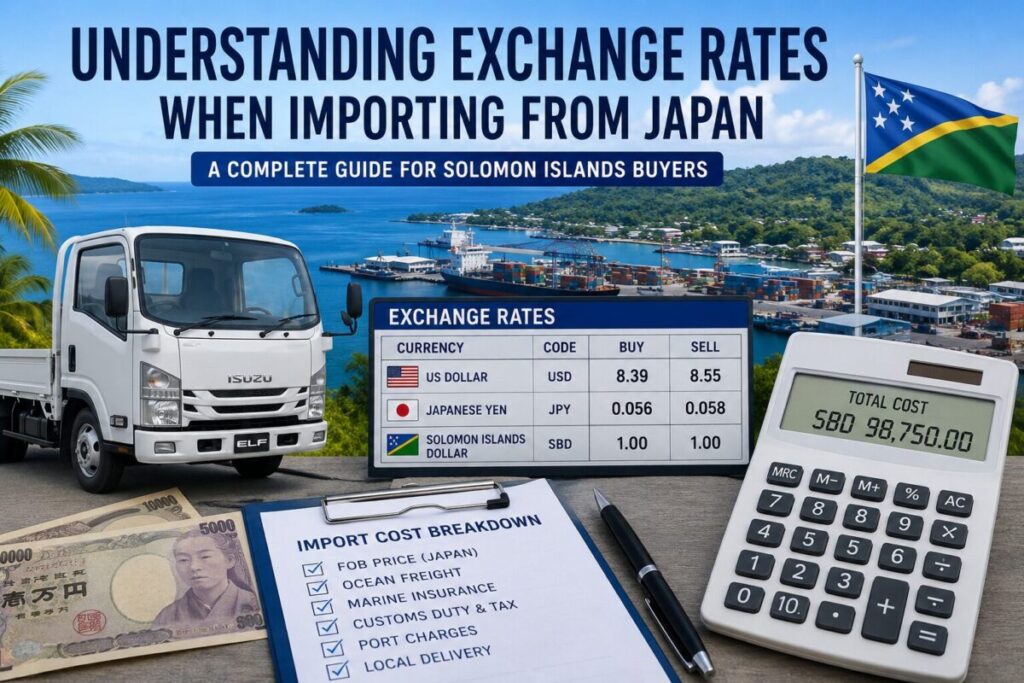

Understanding Exchange Rates When Importing from Japan
Exchange rates can change the real cost of importing a Japanese used truck.
For Solomon Islands buyers, this is very important.
A truck price may look clear in Japan. However, the final amount in Solomon Islands dollars can change before payment, shipping, and clearance.
Therefore, buyers should understand exchange rates before importing.
This guide explains how exchange rates affect used truck imports from Japan to Solomon Islands. It also explains how buyers can plan better, avoid surprise costs, and protect their business budget.
The information in this article is a practical guide. Exchange rates change often, so buyers should always confirm the latest rate with their bank, money transfer service, or finance provider before payment.
Why Exchange Rates Matter for Solomon Islands Buyers
Most Solomon Islands buyers think first about the truck price.
However, the currency conversion also matters.
A Japanese used truck may be quoted in Japanese yen, US dollars, or another currency. The buyer may prepare money in Solomon Islands dollars. Because of this, the final payment depends on the exchange rate.
Even a small rate movement can affect the total cost.
This matters more when buying higher-value trucks, crane trucks, dump trucks, buses, tractors, or machinery.
For example, a small rate change may not feel large on a low-cost part. However, it can become serious on a full truck payment, ocean freight, and import charges.
Therefore, exchange rate planning helps buyers control cost.
Solomon Islands Buyers Often Deal with Several Currencies
Vehicle import payments can involve more than one currency.
Solomon Islands buyers may use Solomon Islands dollars for local funds. The vehicle price may be shown in Japanese yen or US dollars. Shipping and insurance may also be quoted separately.
As a result, buyers should understand these common currencies:
- SBD: Solomon Islands dollar
- JPY: Japanese yen
- USD: US dollar
Many international vehicle deals use USD for easier comparison.
However, the truck comes from Japan. So, Japanese yen can still affect the exporter’s cost and market price.
Because of this, buyers should check both the quotation currency and the payment currency.
How Exchange Rates Affect the FOB Price
FOB price is the vehicle price in Japan before ocean freight and local import costs.
It is often the first number buyers compare.
However, FOB price is not the same as the final cost in Solomon Islands dollars.
For example, if the FOB price is shown in USD, the buyer still needs to convert SBD to USD. If the price is shown in JPY, the buyer needs to convert SBD to JPY or SBD to USD to JPY.
Therefore, the payment route matters.
Before confirming a truck, buyers should ask:
- What currency is the FOB price shown in?
- What currency should the buyer pay in?
- Is the exchange rate fixed or changing?
- How long is the quotation valid?
- Are bank fees included?
- Are transfer fees separate?
These simple questions can prevent confusion.
Why Timing Can Change the Final Price
Exchange rates move over time.
A buyer may receive a quotation on Monday. However, payment may happen several days later. During that time, the rate may change.
This can increase or reduce the final amount in SBD.
Therefore, timing matters.
For Solomon Islands buyers, this is important because business cash flow can be tight. A small difference in exchange rate can affect funds for freight, customs, port charges, or repairs after arrival.
So, buyers should avoid waiting too long after receiving a quotation.
If the truck is a good match, fast confirmation can help reduce exchange rate risk.
Exchange Rates and Total Import Cost
Exchange rates do not affect only the vehicle price.
They can affect many parts of the import budget.
A full import cost may include:
- FOB vehicle price in Japan
- Ocean freight
- Marine insurance
- Bank charges
- Money transfer fees
- Customs duty
- Goods tax
- Port charges
- Clearance fees
- Local transport
- Repairs and service
Some costs may be paid overseas.
Other costs may be paid locally in Solomon Islands.
Because of this, buyers should calculate both foreign currency costs and local currency costs.
This gives a more realistic budget.
Simple Exchange Rate Formula
A simple formula can help buyers estimate the cost.
Foreign Currency Price × Exchange Rate = Estimated Local Currency Cost
For example, if a truck price is quoted in USD, the buyer should calculate how many SBD are needed to buy that USD amount.
However, buyers should remember one thing.
The rate shown online may not be the exact rate used by the bank.
Banks and money transfer companies may use their own rates. They may also charge transfer fees.
Therefore, buyers should ask for the real payment amount before sending money.
Example: Exchange Rate Impact on a Light Truck
Here is a simple example.
This is not a real quotation.
It only shows how exchange rate movement can affect cost.
| Item | Example |
|---|---|
| FOB truck price | US$12,000 |
| Rate example 1 | 1 USD = 8.40 SBD |
| Estimated SBD cost | 100,800 SBD |
| Rate example 2 | 1 USD = 8.60 SBD |
| Estimated SBD cost | 103,200 SBD |
In this example, the truck price stays the same in USD.
However, the SBD cost changes because the exchange rate changes.
This is why buyers should plan early.
Example: Exchange Rate Impact on a Bigger Truck
The effect becomes larger with a higher vehicle price.
A medium truck or crane truck can cost much more than a small delivery truck.
| Item | Example |
|---|---|
| FOB truck price | US$35,000 |
| Rate example 1 | 1 USD = 8.40 SBD |
| Estimated SBD cost | 294,000 SBD |
| Rate example 2 | 1 USD = 8.60 SBD |
| Estimated SBD cost | 301,000 SBD |
The difference becomes bigger because the truck value is higher.
Therefore, exchange rate planning is very important for dump trucks, crane trucks, heavy trucks, and machinery.
Why Japanese Yen Matters Even When Paying in USD
Some buyers may ask one question.
Why does Japanese yen matter if the invoice is in USD?
The reason is simple.
The truck is sourced in Japan. Japanese auction prices, dealer stock prices, and local costs in Japan often relate to yen.
When the yen changes, the Japanese used vehicle market can also change.
For example, strong demand and exchange rate movement can affect auction prices. This can influence the final FOB price offered to overseas buyers.
Therefore, Solomon Islands buyers should watch both USD and JPY trends.
They do not need to become finance experts. However, they should understand that currency movement affects vehicle prices.
Best Truck Types to Compare Before Currency Changes
When exchange rates move, quick comparison becomes useful.
Buyers should compare models, body types, and prices before the quotation changes.
For light-duty work, popular choices include ISUZU ELF, HINO DUTRO, MITSUBISHI CANTER, TOYOTA DYNA, TOYOTA TOYOACE, and NISSAN ATLAS.
These trucks can suit shop delivery, small contractors, market goods, farm supplies, and local transport.
For medium-duty work, buyers may compare ISUZU FORWARD, HINO RANGER, MITSUBISHI FUSO FIGHTER, and NISSAN CONDOR.
These models can support hardware delivery, construction, timber work, wharf support, and regional cargo.
For heavy work, buyers may consider ISUZU GIGA, HINO PROFIA, MITSUBISHI SUPER GREAT, and NISSAN QUON.
These trucks can support bigger loads, port operations, and large business projects.
Solomon Islands Business Needs and Currency Planning
Solomon Islands buyers often buy trucks for real business use.
A truck may support a shop, construction company, farm, fisheries business, timber operator, or transport service.
Because of this, budget accuracy matters.
If the exchange rate changes, the buyer may need more local currency than expected.
This can affect other business costs.
For example, a buyer may still need money for:
- Fuel after arrival
- Tyres
- Battery
- Engine oil
- Filters
- Local delivery
- Registration-related costs
- Minor repairs
- Staff or driver costs
Therefore, buyers should not spend the full budget on the vehicle price only.
They should keep extra funds for arrival costs.
How Exchange Rates Affect Shipping Costs
Shipping costs may also involve foreign currency.
Many shipping quotations use USD or another international currency.
So, SBD exchange rate changes can affect freight cost too.
This matters because freight can be a large cost for trucks.
A small light truck usually costs less to ship than a heavy crane truck. A long truck or tall truck may cost more because shipping companies check dimensions.
Before buying, buyers should confirm:
- Truck length
- Truck width
- Truck height
- Truck weight
- Departure port in Japan
- Arrival port in Solomon Islands
- RORO or container option
- Estimated freight currency
Solomon Islands has key port facilities such as Honiara Port and Noro Port.
Therefore, buyers should confirm the shipping route and arrival point early.
How Exchange Rates Affect Customs Value
Customs value can also depend on currency conversion.
When a vehicle arrives, customs may need to calculate value for duty and tax purposes.
This may involve invoice value, freight, insurance, and exchange conversion.
Because customs rules can change, buyers should confirm details with a licensed customs broker or Solomon Islands Customs before importing.
This is important for accurate planning.
A buyer should not guess the duty and tax amount.
Instead, the buyer should ask for an estimate before the truck leaves Japan.
How to Protect Your Budget from Exchange Rate Risk
Buyers cannot control exchange rates.
However, they can reduce risk with good planning.
1. Ask for a Clear Quotation
First, ask what currency the price uses.
Also, ask how long the quotation is valid.
2. Check the Real Bank Rate
Next, check the rate from your bank or money transfer company.
Do not rely only on online sample rates.
3. Prepare Extra Budget
Then, keep extra money for small currency changes.
This can reduce stress during payment.
4. Avoid Long Delays
After choosing a truck, do not wait too long.
Exchange rates and vehicle availability can change.
5. Confirm All Costs Early
Finally, ask about freight, insurance, documents, and local costs.
This gives a clearer total budget.
Why Direct Import from Japan Can Help
Direct import can help buyers understand cost more clearly.
Instead of buying after many price markups, buyers can see more of the cost structure.
This can include:
- Vehicle price
- Export cost
- Freight cost
- Insurance cost
- Document support
- Local import cost estimate
As a result, buyers can compare value better.
Direct buying does not remove exchange rate risk.
However, it can make the price details easier to understand.
Why the Cheapest Truck May Not Save Money
Exchange rate planning is important.
However, vehicle condition is still more important.
A cheap truck may need expensive repairs after arrival.
For example, the buyer may need new tyres, battery, brake repairs, hydraulic repairs, or engine service.
So, buyers should not choose only by price.
They should check the real value.
Important condition points include:
- Engine condition
- Transmission condition
- Chassis rust
- Tyre condition
- Body floor condition
- Dump operation
- Crane operation
- Cooling unit condition
- Interior condition
- Odometer reading
A better-condition truck may cost more at first.
However, it may save money after arrival.
Exchange Rate Checklist for Solomon Islands Buyers
Before importing a Japanese used truck, check this list.
- What currency is the vehicle price in?
- What currency must I pay?
- What is today’s bank rate?
- How long is the quotation valid?
- Are transfer fees included?
- Are bank charges separate?
- What is the freight currency?
- Is marine insurance included?
- What local customs rate will apply?
- What exchange rate will customs use?
- Do I have extra budget for rate movement?
- Do I have funds for repairs after arrival?
This checklist helps buyers avoid surprise costs.
It also supports better business planning.
How EVERY Japan Supports Better Cost Planning
EVERY Japan supports overseas buyers who need Japanese used trucks, buses, tractors, machinery, and commercial vehicles.
For Solomon Islands buyers, we understand that exchange rates can affect the final budget.
We can help buyers with:
- Used truck search
- Stock vehicle information
- FOB price guidance
- Truck condition checks
- Photos and videos
- Body type advice
- Export document support
- Shipping preparation
- Truck dimension confirmation
- Cost planning support
- Long-term sourcing support
Also, we help buyers compare value, not only price.
A strong truck with clear details can be better than a cheaper truck with many risks.
Therefore, we aim to support practical import decisions.
Final Thoughts
Exchange rates are an important part of importing from Japan.
For Solomon Islands buyers, the final cost can change when SBD, USD, and JPY move.
That is why buyers should check the quotation currency, bank rate, payment timing, freight currency, and local import costs before buying.
Also, buyers should keep extra budget for exchange rate changes and arrival costs.
Japanese used trucks can support shops, farms, contractors, fisheries, ports, and provincial transport across Solomon Islands.
However, the best import decision needs both a good truck and a good cost plan.
With clear exchange rate planning, buyers can import with more confidence.
EVERY Japan is ready to help Solomon Islands buyers find reliable Japanese used trucks with clear information, practical advice, and trusted export support.


Browse Reliable Used Trucks & Buses from Japan
Carefully selected vehicles ready for export worldwide
Search 100,000+ Dealer Stock Vehicles from Japan
Access a wide selection of vehicles from Japanese dealers nationwide. Updated daily.
