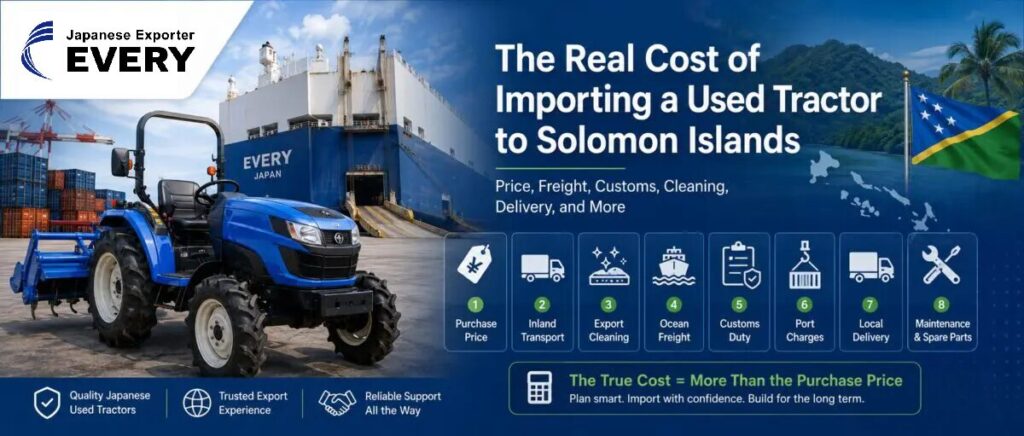

A Japanese used tractor can bring real value to a farm in Solomon Islands.
It can reduce manual work, improve land preparation, and support faster crop production.
However, the advertised tractor price does not show the full import cost.
Freight, cleaning, customs, port fees, local delivery, and repairs can add a large amount.
Therefore, buyers should calculate the complete landed cost before sending payment.
This guide explains every major cost in simple terms.
It also reflects farming, transport, and road conditions across Solomon Islands.
As a result, farmers, contractors, cooperatives, churches, and agribusiness owners can plan a safer purchase.
Why Used Tractors Matter in Solomon Islands
Agriculture supports many households and rural communities across Solomon Islands.
Farmers grow root crops, vegetables, coconuts, cocoa, fruit, and other local products.
However, many farms still depend on hand tools and small-scale labour.
This limits the amount of land that farmers can prepare quickly.
It also makes expansion difficult during busy planting periods.
A compact Japanese tractor can help solve this problem.
For example, it can support ploughing, tilling, mowing, hauling, and land maintenance.
Moreover, a tractor can help commercial growers prepare larger areas with fewer workers.
This benefit matters when labour costs rise or workers remain unavailable.
Still, Solomon Islands farms have different needs.
A small vegetable plot near Honiara needs a different tractor from a cocoa plantation in a province.
Likewise, flat land needs different equipment from steep, wet, or narrow ground.
Therefore, buyers must match the tractor to the actual farm.
The Purchase Price Is Only the Starting Cost
Many buyers first look at the tractor price in Japan.
That price may appear attractive.
Japanese used tractors often offer strong quality, simple controls, and good fuel economy.
However, the tractor must still travel from Japan to Solomon Islands.
It must also pass export, shipping, customs, and biosecurity procedures.
Consequently, the real cost includes much more than the machine price.
A complete budget should include:
- Tractor purchase price
- Japanese inland transport
- Export handling charges
- Cleaning and preparation
- Inspection costs
- Ocean freight
- Marine insurance
- Bank transfer charges
- Foreign exchange costs
- Customs duty and taxes
- Shipping agent charges
- Port handling fees
- Biosecurity inspection
- Possible cleaning or treatment
- Storage charges
- Customs broker fees
- Local delivery costs
- Provincial sea transport
- Initial repairs and servicing
- Attachments and spare parts
Therefore, never use the selling price as your final budget.
Cost 1: The Used Tractor Price in Japan
The purchase price depends on several factors.
These include brand, model, horsepower, age, condition, and operating hours.
Four-wheel drive models may cost more than two-wheel drive models.
Likewise, tractors with power steering often carry a higher price.
A front loader can also increase the total cost.
However, a cheaper tractor does not always save money.
A very old machine may need tyres, seals, hoses, batteries, or engine work.
Therefore, buyers should compare condition instead of price alone.
Popular Japanese Tractor Brands
Solomon Islands buyers can consider a KUBOTA TRACTOR for compact farming work.
These tractors often suit gardens, vegetable farms, and small plantations.
A YANMAR TRACTOR can also support light and medium farm tasks.
Meanwhile, an ISEKI TRACTOR may suit soil preparation and field maintenance.
Buyers can also consider a MITSUBISHI TRACTOR for general agricultural work.
For larger work, a JOHN DEERE TRACTOR may provide more power.
A MASSEY FERGUSON TRACTOR may also suit bigger farms and commercial operations.
Other options include a NEW HOLLAND TRACTOR or FORD TRACTOR.
However, brand choice should not come first.
Instead, start with the farm size, soil, slope, and intended work.
Cost 2: Tractor Inspection Before Purchase
A remote purchase requires careful inspection.
You cannot easily return a tractor after it reaches Solomon Islands.
Therefore, inspection can prevent a much larger loss.
Ask the exporter to check:
- Engine starting condition
- Exhaust smoke
- Engine oil leaks
- Coolant leaks
- Hydraulic oil leaks
- Transmission operation
- Clutch condition
- Power steering
- Four-wheel drive operation
- PTO operation
- Hydraulic lift operation
- Brake performance
- Tyre condition
- Electrical system
- Hour meter
- Safety frame or canopy
Moreover, request a cold-start video.
A warm engine can hide starting problems.
Also, request a video of the hydraulic arms lifting a heavy attachment.
This helps reveal weak hydraulic pressure.
Inspection may increase the initial cost.
Nevertheless, it can prevent expensive repairs after arrival.
Cost 3: Japanese Inland Transport
The tractor may not sit near the export port.
It may come from an auction, dealer yard, farm, or machinery supplier.
Therefore, it needs transport to the exporter or shipping port.
The inland cost depends on distance and machine size.
A compact tractor costs less to move than a large agricultural tractor.
Attachments also affect the transport cost.
For example, a wide rotary tiller may require extra space.
Likewise, a front loader can increase the total dimensions.
Ask whether the quoted price includes Japanese inland delivery.
If it does not, add this cost before comparing suppliers.
Cost 4: Export Preparation and Documentation
The exporter must prepare the tractor for international shipment.
This process can include photographs, measurements, invoicing, and export documents.
The exporter may also remove loose parts or secure attachments.
In addition, shipping companies need accurate dimensions and weight.
Incorrect measurements can change the freight cost later.
Therefore, request a clear breakdown of export handling charges.
Important documents may include:
- Proforma invoice
- Commercial invoice
- Packing list
- Export documents
- Bill of lading
- Cleaning certificate, when available
- Inspection report
- Marine insurance document, when purchased
Keep copies of every document.
You may need them for banking, customs, and port clearance.
Cost 5: Professional Cleaning in Japan
Cleaning is one of the most important tractor import costs.
A used agricultural tractor may contain soil in many hidden areas.
It may also carry seeds, grass, leaves, insects, or plant material.
These materials create a biosecurity risk.
Therefore, a simple exterior wash may not provide enough protection.
The cleaning team should inspect:
- Tyre treads
- Wheel rims
- Axles
- Underbody panels
- Engine bay
- Radiator area
- Battery tray
- Foot plates
- Seat base
- Hydraulic arms
- Three-point linkage
- PTO housing
- Drawbar
- Front weights
- Loader frame
- Rotary tiller
Rotary tillers need special attention.
Wet soil can remain around blades, covers, shafts, and guards.
Likewise, grass can remain wrapped around moving parts.
Therefore, some attachments may need partial dismantling.
Professional cleaning adds cost in Japan.
However, it usually costs less than cleaning after arrival.
Cost 6: Ocean Freight from Japan
Ocean freight may form a major part of the landed cost.
The final amount depends on the shipping method.
It also depends on the tractor’s dimensions, weight, and destination.
Common shipping options include RoRo and container shipping.
RoRo Shipping
RoRo means roll-on and roll-off shipping.
A working tractor can move onto the vessel through a ramp.
This method may suit tractors that start, steer, and brake correctly.
RoRo often reduces packing work.
However, sailing routes and acceptance rules can change.
Some carriers may not accept loose attachments.
Therefore, confirm the booking conditions before payment.
Container Shipping
A compact tractor may fit inside a shipping container.
This method can protect it from open handling and weather.
It may also allow spare parts and attachments to travel together.
However, container loading creates extra costs.
These may include packing, loading, securing, and unloading.
A large tractor may require wheel or attachment removal.
Consequently, labour costs can increase.
Shared Container Shipping
A shared container may reduce freight for a small tractor.
The exporter can load it with other suitable cargo.
However, the shipment may wait for enough cargo.
Therefore, shared shipping can take longer.
It can also create more handling during loading and unloading.
Cost 7: Marine Insurance
Marine insurance protects against certain shipping risks.
It may cover loss or major damage under the policy terms.
However, it does not cover every mechanical problem.
It also may not cover poor maintenance or normal wear.
Therefore, read the insurance conditions before paying.
Ask what evidence you need for a claim.
Usually, buyers should keep loading photos and arrival photos.
They should also report damage quickly.
Insurance adds a smaller cost than the tractor itself.
Nevertheless, it can protect a major investment.
Cost 8: International Bank and Exchange Fees
Most exporters request payment in Japanese yen or United States dollars.
However, Solomon Islands buyers often hold Solomon Islands dollars.
Therefore, the bank must convert the currency.
The exchange rate can change the final purchase cost.
In addition, the buyer may pay:
- International transfer fee
- Foreign exchange margin
- Correspondent bank charge
- Beneficiary bank charge
- Document processing fee
Ask the bank how much the exporter will receive.
Otherwise, bank deductions may create a payment shortage.
The exporter may delay shipping until it receives the full amount.
Cost 9: Customs Duty and Import Taxes
Solomon Islands Customs will assess the imported tractor.
The assessment may depend on its classification and customs value.
The customs value may include more than the purchase price.
Freight and insurance can also affect the calculation.
Therefore, never estimate duty from the tractor price alone.
Before buying, send the following details to a customs broker:
- Tractor make
- Tractor model
- Year of manufacture
- Engine type
- Engine power
- Purchase price
- Freight amount
- Insurance amount
- Country of origin
- Intended agricultural use
Ask for a written landed-cost estimate.
However, remember that Customs makes the final assessment.
Do not ask the exporter to lower the invoice value falsely.
An incorrect declaration can cause delay, penalties, or revaluation.
Cost 10: Shipping Agent and Port Charges
The tractor will create destination charges after arrival.
These charges differ from the ocean freight paid in Japan.
Possible destination expenses include:
- Shipping agent fee
- Delivery order fee
- Port handling charge
- Wharf charge
- Equipment use
- Container handling
- Documentation fee
- Storage fee
These costs can surprise first-time importers.
Therefore, contact the local shipping agent before the vessel arrives.
Ask for the expected destination charge schedule.
Also, prepare payment early.
A delay can lead to daily storage charges.
Cost 11: Biosecurity Inspection in Solomon Islands
Used tractors receive close biosecurity attention.
This makes sense because they work directly in soil and vegetation.
Biosecurity officers may inspect the tractor after arrival.
They can examine tyres, axles, underbody areas, and attachments.
If they find contamination, the tractor may need more cleaning.
It may also remain in a controlled port area.
This can create:
- Inspection fees
- Cleaning costs
- Labour charges
- Equipment hire
- Storage charges
- Reinspection fees
- Delays in release
Therefore, offshore cleaning offers real financial value.
Ask the exporter for detailed cleaning photographs.
Also, request photos beneath the tractor and inside the wheels.
A shiny bonnet does not prove that the tractor is clean underneath.
Cost 12: Customs Broker Fees
A customs broker can prepare and submit the import declaration.
The broker can also explain required documents and charges.
This service adds a fee.
However, it can reduce mistakes and clearance delays.
A first-time tractor importer may benefit greatly from broker support.
Contact the broker before shipment.
Do not wait until the tractor reaches Honiara.
Early contact gives the broker time to review the documents.
Cost 13: Storage and Delay Charges
Storage can become one of the most avoidable import costs.
Charges may begin when free port time ends.
Several problems can delay release:
- Missing original documents
- Incorrect consignee name
- Unpaid customs charges
- Late shipping agent payment
- Biosecurity contamination
- Incorrect cargo description
- Banking delays
- No local transport arrangement
Therefore, prepare documents and funds before arrival.
Track the vessel schedule with the exporter or shipping agent.
Then, begin clearance as soon as the documents become available.
Cost 14: Delivery from Honiara to the Farm
Port release does not complete the journey.
The tractor must still reach the farm or project site.
A buyer near Honiara may use a flatbed truck.
However, a provincial buyer may need another vessel.
This can create a major additional cost.
For example, delivery may require:
- Transport from the port
- Flatbed truck hire
- Crane or forklift hire
- Coastal vessel booking
- Provincial wharf charges
- Loading and unloading labour
- Fuel
- Security and storage
Large tractors need suitable loading equipment.
Some provincial wharves may have limited lifting capacity.
Therefore, confirm unloading arrangements before choosing the tractor.
A compact model may cost less to transport between islands.
How Road Conditions Affect the Real Cost
Many rural routes have gravel, mud, potholes, and water damage.
Heavy rain can make access harder.
Therefore, the cheapest transport quotation may not cover the final farm route.
A delivery truck may stop before reaching the property.
The buyer may then need local machinery or extra labour.
Moreover, steep or soft ground can affect tractor suitability.
A heavy tractor may sink into wet soil.
A wide tractor may struggle on narrow plantation tracks.
Consequently, size affects both performance and delivery cost.
Cost 15: Initial Servicing After Arrival
A used tractor should receive basic servicing before hard work.
Long storage and sea transport can affect batteries and fluids.
Therefore, budget for:
- Engine oil
- Oil filter
- Fuel filter
- Air filter
- Coolant
- Hydraulic oil
- Transmission oil
- Grease
- Battery testing
- Fan belt inspection
- Radiator cleaning
Also, check every fluid level before starting field work.
A small service cost can prevent major engine damage.
Cost 16: Tyres, Batteries, and Wear Parts
Tyres can add a large cost to a cheap tractor.
A tractor may look good while having cracked or worn tyres.
Replacement sizes may also remain difficult to find locally.
Therefore, inspect the tyre walls and tread closely.
Ask for clear photographs from both sides.
The battery also matters.
Heat, storage, and sea transport can weaken an old battery.
Other common wear parts include:
- Belts
- Hoses
- Oil seals
- Hydraulic hoses
- Clutch parts
- Brake parts
- Steering joints
- Wheel bearings
- Glow plugs
Ask the exporter about parts availability before buying a rare model.
Cost 17: Implements and Attachments
A tractor alone cannot complete every farm task.
The correct attachment creates most of its practical value.
Common implements include:
- Rotary tiller
- Plough
- Disc harrow
- Slasher
- Trailer
- Front loader
- Rear blade
- Post-hole digger
However, every attachment adds freight weight and volume.
It may also increase cleaning work.
Therefore, compare two options.
You can import the correct attachment with the tractor.
Alternatively, you can source or build a suitable attachment locally.
Check the PTO size, rotation, linkage category, and hydraulic connections.
An incompatible attachment has little value.
Cost 18: Fuel and Daily Operating Costs
The import price is only part of tractor ownership.
Fuel creates a regular business cost.
A larger engine uses more fuel during light work.
Therefore, avoid buying unnecessary horsepower.
A compact diesel tractor may suit:
- Vegetable farms
- Small cocoa blocks
- Coconut land maintenance
- Community gardens
- School farms
- Landscaping work
A larger tractor may suit broad land preparation and heavy hauling.
However, it needs more fuel and wider access.
Choose the smallest tractor that can complete the work safely.
Cost 19: Mechanic and Spare-Parts Access
A tractor has little value when nobody can repair it.
Therefore, ask local mechanics which brands they understand.
Also, check parts access before ordering.
Common filters and belts may remain easy to source.
However, model-specific electrical and transmission parts may take longer.
Shipping one small part from overseas can become expensive.
It can also stop farm work for several weeks.
Consequently, a familiar model may offer better long-term value.
A Practical Landed-Cost Formula
Use the following structure when preparing your budget:
Tractor price + Japan transport + export preparation + cleaning + freight + insurance + bank fees + customs charges + port costs + biosecurity + broker fees + local delivery + initial service.
Then, add a contingency amount.
A contingency can cover currency changes, delays, cleaning, or small repairs.
Without this reserve, one unexpected fee can stop the clearance process.
Example Budget Structure
Consider a farmer importing a compact four-wheel-drive tractor.
The machine includes a rotary tiller.
The buyer should not calculate only the tractor and freight.
Instead, the budget should have separate sections.
Costs Paid in Japan
- Tractor purchase
- Auction or dealer charges
- Inland transport
- Inspection
- Cleaning
- Export handling
- Container loading or RoRo preparation
International Costs
- Ocean freight
- Marine insurance
- Bank transfer fee
- Currency conversion
Costs Paid in Solomon Islands
- Customs duty and taxes
- Shipping agent charges
- Port fees
- Biosecurity inspection
- Customs broker
- Storage, when applicable
- Local delivery
- Provincial shipping
Costs After Delivery
- Oil and filters
- Battery
- Tyre repair
- Spare parts
- Operator training
- Fuel
This structure gives the buyer a more realistic total.
Which Tractor Size Suits Solomon Islands Farms?
Small Compact Tractors
Small tractors can suit narrow fields and community gardens.
They also fit more easily inside containers.
Moreover, they use less fuel.
However, they may lack power for heavy land clearing.
Medium Tractors
Medium tractors can support wider farm work.
They may handle larger tillers, trailers, and slashers.
Still, they need stronger access roads and more turning space.
Large Tractors
Large tractors suit commercial operations and heavy work.
However, they create higher freight and delivery costs.
They also need more fuel, stronger bridges, and suitable unloading equipment.
Therefore, large power does not always mean better value.
Questions to Ask the Exporter Before Buying
- Does the tractor start from cold?
- Does the engine produce heavy smoke?
- Does the PTO work correctly?
- Does the hydraulic lift hold weight?
- Does four-wheel drive engage?
- Are there oil or coolant leaks?
- Are the tyres cracked or damaged?
- Does the hour meter work?
- What attachments come with the tractor?
- Has the machine received export cleaning?
- Can you provide underbody photographs?
- What shipping method will you use?
- Does the quotation include Japanese port costs?
- Does the quotation include freight?
- What documents will you provide?
How to Reduce the Total Import Cost
First, choose the correct tractor size.
Oversized machinery increases freight, fuel, and delivery costs.
Second, buy a model with available parts.
Third, inspect the tractor before payment.
Fourth, arrange professional cleaning in Japan.
Fifth, compare RoRo and container freight.
Sixth, ask a broker for a customs estimate.
Seventh, prepare port funds before arrival.
Finally, arrange local delivery early.
These steps reduce expensive surprises.
Common Costly Mistakes
- Buying only because the tractor looks cheap
- Choosing too much horsepower
- Ignoring tyre condition
- Failing to test the PTO
- Shipping a dirty rotary tiller
- Forgetting Japanese inland transport
- Ignoring destination port charges
- Estimating customs without professional advice
- Waiting until arrival to arrange clearance
- Forgetting provincial delivery costs
- Buying a rare model with limited parts
- Using the full budget before customs clearance
Final Advice for Solomon Islands Tractor Buyers
A Japanese used tractor can improve farming productivity.
It can save labour, prepare more land, and support commercial growth.
However, the purchase price shows only one part of the investment.
The real cost begins with the tractor and ends at the farm.
Therefore, calculate every stage before payment.
Include Japanese transport, cleaning, freight, customs, port fees, and local delivery.
Also, keep money for servicing, tyres, batteries, and spare parts.
Most importantly, choose a tractor that matches local land and transport conditions.
A smaller reliable tractor may offer better value than a large cheap machine.
With careful planning, Solomon Islands buyers can import dependable farm equipment with greater confidence.


Browse Reliable Used Trucks & Buses from Japan
Carefully selected vehicles ready for export worldwide
Search 100,000+ Dealer Stock Vehicles from Japan
Access a wide selection of vehicles from Japanese dealers nationwide. Updated daily.
