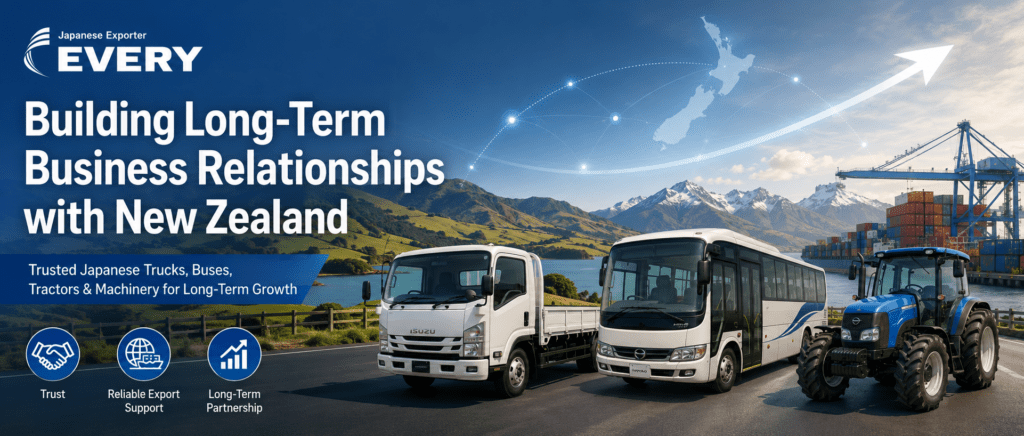

Building Long-Term Trust with New Zealand
Good business takes time.
It needs trust.
It needs clear communication.
It also needs steady support after the first deal.
For New Zealand buyers, this is very important.
A used truck is not only a vehicle.
A tractor is not only a machine.
A bus is not only transport.
Each one supports real work, real income, and real communities.
That is why EVERY Japan wants to build long-term business relationships with New Zealand buyers.
New Zealand needs reliable vehicles for farming, freight, construction, tourism, trade work, and regional business. Japan can support that need with right-hand-drive used trucks, buses, tractors, mini trucks, and machinery.
However, long-term business needs more than low prices.
It needs honest vehicle information.
It needs careful condition checking.
It needs correct export documents.
It needs smooth shipping support.
Also, it needs respect for New Zealand’s import, inspection, and biosecurity requirements.
New Zealand’s freight strategy focuses on a freight and supply chain system that is resilient, reliable, productive, and efficient. This shows how important dependable transport is for the country.
So, buyers need suppliers they can trust again and again.
This article explains how EVERY Japan builds long-term relationships with New Zealand customers.
Why Long-Term Relationships Matter in Vehicle Import
Importing a used commercial vehicle is a serious decision.
A farmer may need a truck for daily farm supply.
A contractor may need a dump truck for construction work.
A freight company may need a delivery vehicle for customer contracts.
A tourism operator may need a bus before the busy season.
If the vehicle is wrong, the buyer loses time and money.
Therefore, New Zealand buyers need more than a simple seller.
They need a partner.
A partner helps them think about the right model, body type, condition, import process, and future needs.
This is especially true for first-time importers. It is also true for repeat buyers who want to build a fleet over time.
At EVERY Japan, we believe that one successful purchase should lead to long-term confidence.
That is the heart of good export business.
New Zealand and Japan Already Have Strong Connections
Japan and New Zealand have a strong relationship.
Both countries share important regional trade links. The New Zealand Ministry of Foreign Affairs and Trade notes that Japan and New Zealand are both part of major trade frameworks such as CPTPP and RCEP. It also highlights strong cultural links and more than 40 active Sister City and Friendly City relationships.
This matters for business.
Trade works better when countries understand each other.
Communication works better when trust already exists.
Also, long-term cooperation becomes easier when both sides value quality and reliability.
Japanese used vehicles have strong appeal in New Zealand because both countries use right-hand-drive roads. Also, many New Zealand buyers already know Japanese vehicle brands.
Toyota, Isuzu, Hino, Mitsubishi Fuso, Nissan, Kubota, Yanmar, and Iseki are familiar names in many markets.
As a result, Japanese used commercial vehicles can fit New Zealand very well.
New Zealand Businesses Need Reliable Support
New Zealand has many small and regional businesses.
Small businesses make up around 97% of all enterprises in New Zealand and contribute about 42% of total economic value, according to MBIE.
This makes affordable and reliable vehicles very important.
A small business may not want the cost of a new truck.
A farmer may need practical machinery at a fair price.
A rural contractor may need strong equipment without heavy financial pressure.
A tourism operator may need a clean bus before peak demand.
Japanese used vehicles can help.
They offer many choices:
- Light trucks
- Medium trucks
- Heavy trucks
- 4WD trucks
- Mini trucks
- Buses
- Vans
- Tractors
- Forklifts
- Excavators
- Farm machinery
- Construction machinery
However, every buyer has a different job.
So, long-term support matters.
A one-time sale may solve one problem.
A long-term relationship can support many future needs.
How EVERY Japan Builds Long-Term Business Relationships
1. We Listen Before We Recommend
Every good relationship starts with listening.
Before we recommend a vehicle, we want to understand the buyer’s real purpose.
For example:
- What will the vehicle carry?
- Where will it work?
- Will it drive on public roads?
- Does it need 4WD?
- Will it carry people?
- Will it work on farms?
- Will it enter construction sites?
- Does it need refrigeration?
- Does it need a crane or dump body?
- Is it for private property or business use?
This matters in New Zealand.
A truck for Auckland delivery is different from a truck for rural Southland. A tractor for a vineyard is different from a tractor for dairy support. A bus for a hotel shuttle is different from a bus for community transport.
Therefore, we do not only ask, “What is your budget?”
We ask, “What do you need the vehicle to do?”
That helps us build better long-term trust.
2. We Recommend Vehicles for Real New Zealand Conditions
New Zealand roads and job sites vary widely.
Some roads are urban and busy.
Some are rural and narrow.
Some are steep.
Some areas have gravel or farm access tracks.
Also, weather can change quickly.
Because of this, vehicle choice must match real conditions.
For example, a 4WD light truck may suit a rural contractor better than a normal 2WD model. A compact tractor may suit a vineyard better than a large tractor. A small Toyota Coaster may suit community transport better than a large coach.
EVERY Japan helps buyers think about these details.
We can support vehicle choices for:
- Farms
- Orchards
- Vineyards
- Construction companies
- Landscaping businesses
- Freight operators
- Food delivery companies
- Tourism operators
- Hotels and lodges
- Community groups
- Lifestyle block owners
- Regional suppliers
As a result, buyers can choose vehicles that fit their daily work.
That is better than choosing only by price.
3. We Provide Clear Vehicle Information
Trust grows when information is clear.
New Zealand buyers often buy from far away. They cannot inspect the vehicle in Japan by themselves.
So, details matter.
EVERY Japan can help buyers check:
- Exterior condition
- Interior condition
- Engine bay
- Odometer
- Tyres
- Underbody
- Chassis rust
- Cargo body
- Seats
- Air conditioning
- Hydraulic equipment
- PTO and linkage
- Crane or dump function
- Refrigeration unit
- Auction sheet details
Photos and videos can reduce risk.
They also help buyers compare options more fairly.
A cheap vehicle with hidden problems may not be a good deal. A slightly higher-priced vehicle with better condition may be better for long-term business.
Clear information supports better decisions.
4. We Help Buyers Understand Japanese Auctions
Japanese auctions offer many opportunities.
They can help buyers find specific vehicles, special body types, and better price options.
However, auctions can feel difficult for new buyers.
Auction sheets may include grades, marks, comments, rust notes, and equipment details. The meaning is not always simple.
EVERY Japan helps buyers understand important points.
For example:
- A small scratch may not be a serious issue.
- Chassis corrosion needs careful review.
- Interior grade matters more for buses.
- PTO and hydraulics matter for tractors.
- Body function matters for dump and crane trucks.
- Cooling performance matters for refrigerated trucks.
Therefore, we help buyers look beyond the auction grade.
This builds confidence over time.
When buyers understand the process, they can make smarter choices in future purchases.
5. We Support Export Documents
Documents are a key part of long-term trust.
A good vehicle still needs correct export paperwork.
New Zealand has clear vehicle import steps. NZTA explains that imported vehicles must meet standards, complete border inspection, entry certification, registration, and licensing before road use. It also says a vehicle registered overseas may not always meet New Zealand standards.
Therefore, documents must be prepared carefully.
EVERY Japan supports export-side documents such as:
- Invoice
- Export certificate
- Vehicle details
- Chassis number
- Model code
- Odometer information
- Shipping information
- Bill of lading support details
Buyers should also confirm local New Zealand requirements with their certifier, agent, or relevant authority.
However, accurate export documents from Japan can make the process smoother.
That is one way we support long-term business.
6. We Respect New Zealand Biosecurity Rules
New Zealand protects its environment carefully.
This matters for every used vehicle import, especially tractors, machinery, trucks, mini trucks, and 4WD vehicles.
Used vehicles and machinery can carry soil, seeds, plant matter, insects, and pests. Therefore, New Zealand biosecurity preparation is very important.
EVERY Japan helps buyers understand cleaning risk before shipping.
Important areas include:
- Underbody
- Wheel arches
- Tyres
- Spare tyre areas
- Cargo beds
- Dump bodies
- Crane bases
- Engine bays
- Cabin floors
- Tractor PTO areas
- Three-point linkage
- Loader buckets
- Rotary tillers
- Excavator tracks
This is not only about passing inspection.
It is about respecting New Zealand’s farms, forests, crops, and natural land.
A supplier that understands this responsibility can build stronger relationships with New Zealand buyers.
7. We Support Different Buyer Types
Long-term business means understanding different customers.
New Zealand buyers are not all the same.
Farmers
Farmers may need flat deck trucks, 4WD mini trucks, compact tractors, loaders, and farm machinery.
They care about durability, easy use, tyres, 4WD, PTO, hydraulics, and cleaning risk.
Contractors
Contractors may need dump trucks, crane trucks, flat decks, excavators, and loaders.
They care about body strength, hydraulic function, rust, and job-site performance.
Freight Companies
Freight businesses may need box trucks, curtain side trucks, refrigerated trucks, and heavy trucks.
They care about payload, fuel use, body size, route type, and downtime.
Tourism Operators
Tourism buyers may need Toyota Coaster, Mitsubishi Rosa, Nissan Civilian, or Toyota Hiace Commuter.
They care about seats, air conditioning, luggage space, comfort, and road suitability.
Regional Businesses
Regional companies may need affordable, reliable vehicles that can handle mixed roads and daily use.
They care about value, support, and long-term reliability.
EVERY Japan works with these needs carefully.
That creates better customer relationships.
Why Long-Term Buyers Benefit from EVERY Japan
Better Vehicle Matching Over Time
The more we understand a buyer’s business, the better we can support future purchases.
For example, a buyer may start with one Isuzu Elf. Later, they may need a Hino Ranger or a refrigerated truck. A farmer may start with a mini truck, then later need a tractor.
Long-term communication helps us understand these steps.
Faster Communication
Repeat customers do not need to explain everything again.
We can remember their preferred vehicle types, budget range, business use, and important concerns.
This makes future transactions smoother.
More Accurate Search Support
When we know a buyer’s needs, we can search more effectively.
We can focus on the right model, year, body type, mileage, and condition.
This saves time.
Better Risk Awareness
Long-term relationships help us understand each buyer’s risk tolerance.
Some buyers want lower prices. Others want cleaner condition. Some want only specific models. Others want strong body equipment.
When we understand this, we can give better advice.
Stronger Trust
Trust grows from repeated good communication.
When buyers feel supported, they can purchase with more confidence.
That is the goal.
Japanese Used Vehicles That Support Long-Term Growth
Light Trucks
Light trucks are popular for farms, trades, delivery, and small business.
Good options include:
They offer practical size and strong daily value.
Medium Trucks
Medium trucks support growing companies.
Good options include:
They suit regional freight, construction supply, and heavier delivery.
Heavy Trucks
Heavy trucks support large business operations.
Good options include:
They suit long-distance freight, containers, and heavy construction.
Buses
Used Japanese buses support tourism, hotels, schools, clubs, and community transport.
Good options include:
They help move people safely and efficiently.
Tractors and Machinery
Japanese tractors and machinery support farms, orchards, vineyards, landscaping, and contractors.
Good options include:
- Kubota tractors
- Yanmar tractors
- Iseki tractors
- Mini excavators
- Forklifts
- Wheel loaders
- Rotary tillers
- Mowers
They can help businesses grow with practical equipment.
What New Zealand Buyers Should Look for in a Long-Term Export Partner
Honest Communication
A good partner gives clear information.
They do not hide risk points.
Vehicle Knowledge
A good partner understands model differences, body types, and real business use.
Export Experience
A good partner knows how to prepare documents and shipping.
New Zealand Awareness
A good partner understands New Zealand road, business, inspection, and biosecurity concerns.
Photo and Video Support
A good partner helps buyers see the vehicle clearly before purchase.
Long-Term Mindset
A good partner wants repeat trust, not only one sale.
This is the kind of relationship EVERY Japan aims to build.
Building Trust Through Every Step
Before Purchase
We help buyers understand options, condition, and suitable models.
During Purchase
We support clear communication and confirm important details.
Before Shipping
We help prepare export documents, shipping information, and condition checks.
After Export
We continue communication and support the buyer’s next needs.
This step-by-step approach helps turn a first purchase into a long-term relationship.
Why New Zealand Is an Important Market for EVERY Japan
New Zealand is a practical and trust-focused market.
Buyers value reliability.
They value clear details.
They value good communication.
They also value long-term support.
This matches EVERY Japan’s export approach.
We do not want to sell only one vehicle.
We want to support customers over time.
As New Zealand businesses grow, their vehicle needs can change. A small delivery business may expand into regional freight. A farm may add more machinery. A contractor may need larger trucks. A tourism operator may add more buses.
EVERY Japan wants to support that growth with reliable Japanese used vehicles.
Final Thoughts
Long-term business relationships with New Zealand are built on trust, communication, and real support.
Japanese used vehicles can help New Zealand farmers, contractors, freight companies, tourism operators, regional businesses, and lifestyle block owners.
They offer right-hand-drive layout, practical models, strong brands, and many body choices.
However, a good export relationship needs more than vehicle supply.
It needs careful listening, clear information, honest condition checks, proper documents, shipping support, and awareness of New Zealand import and biosecurity needs.
EVERY Japan aims to provide that support.
We want every buyer to feel confident before purchase, during export, and when planning future vehicles.
With the right long-term partner, importing Japanese used vehicles can become a reliable way to support business growth in New Zealand.


Browse Reliable Used Trucks & Buses from Japan
Carefully selected vehicles ready for export worldwide
Search 100,000+ Dealer Stock Vehicles from Japan
Access a wide selection of vehicles from Japanese dealers nationwide. Updated daily.
