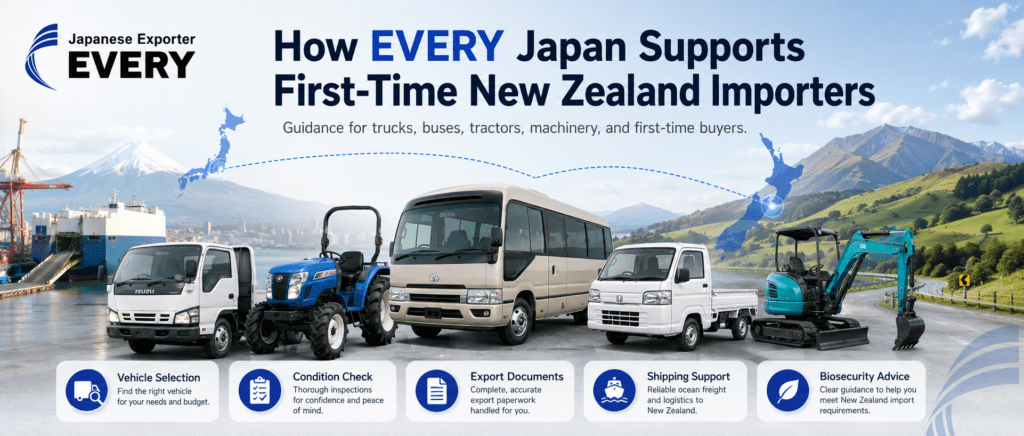

How EVERY Supports First-Time NZ Importers
Importing from Japan can feel exciting.
However, it can also feel confusing at first.
A buyer may find a good truck online.
A farmer may want a Japanese tractor.
A contractor may need a dump truck.
A tourism operator may need a bus.
Also, a small business may want a reliable delivery vehicle.
Yet many first-time New Zealand importers ask the same questions.
Is the vehicle suitable for New Zealand?
Can I trust the condition?
What documents do I need?
How does shipping work?
What about biosecurity cleaning?
Will the vehicle pass inspection?
How can I avoid delays?
These are important questions.
New Zealand has clear import steps. Used vehicles from Japan need evidence that they meet approved standards before road registration. NZTA also explains that imported vehicles must go through border inspection, entry certification, registration, and licensing before road use.
In addition, New Zealand has strict biosecurity rules. MPI explains that vehicles, machinery, tyres, and parts often carry soil, plant matter, animals, pests, and diseases. Therefore, importers must meet biosecurity requirements before clearance.
So, first-time importers need more than a vehicle.
They need guidance.
That is where EVERY Japan can help.
Why New Zealand Buyers Import Used Vehicles from Japan
Japan is a strong source for used vehicles.
It offers many right-hand-drive cars, trucks, buses, tractors, and machinery. This matters because New Zealand also uses right-hand-drive vehicles.
Also, Japanese used vehicles often offer a good balance of quality, price, and choice.
For New Zealand buyers, Japan can provide:
- Used light trucks
- Used medium trucks
- Used heavy trucks
- Used 4WD trucks
- Used buses
- Used mini trucks
- Used tractors
- Used forklifts
- Used excavators
- Used farm machinery
- Used construction machinery
This variety is useful.
New Zealand has many different business needs. Farmers need tractors and flat deck trucks. Contractors need dump trucks and machinery. Freight operators need reliable delivery trucks. Hotels and tour companies need buses and vans.
The Ministry of Transport says New Zealand’s freight and supply chain strategy provides long-term direction for the country’s freight system. It also focuses on a resilient, reliable, productive, and efficient network.
Therefore, commercial vehicles support real work across New Zealand.
A good Japanese used vehicle can help a business move faster, serve customers better, and control costs.
Why First-Time Importers Need Careful Support
First-time importers often focus on the vehicle price.
That is natural.
However, the final result depends on many other points.
A cheap truck may need repairs.
A nice bus may need interior checks.
A tractor may need deep cleaning.
A machine may need biosecurity attention.
A vehicle may need correct standard evidence.
So, the process has several steps.
First, the buyer must choose the right vehicle.
Next, they must check condition.
Then, they must prepare documents.
After that, shipping and import steps begin.
New Zealand importers must also think about border inspection, entry certification, biosecurity cleaning, and local compliance. NZTA explains that used vehicles need evidence of approved standards before registration, while MPI explains that vehicles and machinery must meet biosecurity requirements.
Because of this, support matters.
EVERY Japan helps buyers understand the vehicle before they decide.
That can reduce risk and improve confidence.
How EVERY Japan Supports First-Time New Zealand Importers
1. We Help Buyers Choose the Right Vehicle
The best vehicle is not always the cheapest vehicle.
It should match the buyer’s job.
A farm may need a 4WD mini truck.
A contractor may need a dump truck.
A food company may need a refrigerator truck.
A hotel may need a Toyota Coaster.
A vineyard may need a compact tractor.
A regional freight business may need a medium-duty truck.
EVERY Japan helps buyers compare options by real use.
We can help buyers think about:
- Vehicle size
- Body type
- Payload
- Engine type
- Transmission
- 4WD needs
- Road conditions
- Cargo type
- Passenger needs
- Business purpose
- Budget
- Shipping plan
This is very important for New Zealand.
City delivery in Auckland is different from rural farm use in Waikato. Tourism shuttle work in Queenstown is different from construction supply in Christchurch. Farm access roads are also different from urban delivery routes.
So, the vehicle should match the environment.
2. We Explain Japanese Vehicle Types Clearly
Japan has many models and body types.
First-time importers may not know the differences.
For example, light trucks include Isuzu Elf, Hino Dutro, Mitsubishi Fuso Canter, Toyota Dyna, and Toyota Toyoace.
Medium trucks include Isuzu Forward, Hino Ranger, Mitsubishi Fuso Fighter, and Nissan Condor.
Heavy trucks include Isuzu Giga, Hino Profia, Mitsubishi Super Great, and UD Quon.
Buses include Toyota Coaster, Nissan Civilian, Mitsubishi Rosa, Hino Liesse, and Toyota Hiace Commuter.
Tractors include Kubota, Yanmar, Iseki, Mitsubishi, and Shibaura.
Mini trucks include Suzuki Carry, Daihatsu Hijet, Subaru Sambar, Honda Acty, and Mitsubishi Minicab.
EVERY Japan helps buyers understand these choices.
This makes the process easier.
A buyer does not need to know every Japanese model at the start. They only need to explain the job, budget, and use.
Then, our team can help suggest suitable options.
3. We Support Stock Search and Auction Search
Japan has a large used vehicle market.
Buyers can choose from stock vehicles and auction vehicles.
Stock vehicles are often easier for first-time importers. The vehicle is already available. Photos, details, and export preparation can start quickly.
Auction vehicles offer more choice. They can help buyers find a specific model, body type, year, or budget range.
EVERY Japan can support both options.
We can help search for:
- Used trucks
- Used buses
- Used tractors
- Used mini trucks
- Used machinery
- Used vans
- Used 4WD vehicles
- Used construction equipment
For first-time importers, this support is useful.
Instead of searching alone, buyers can receive guidance based on real New Zealand needs.
4. We Help Check Vehicle Condition
Condition is one of the biggest concerns for first-time importers.
Photos can help.
Videos can help even more.
EVERY Japan can help buyers request and review condition details.
Useful checks include:
- Exterior photos
- Interior photos
- Engine bay photos
- Odometer photos
- Tyre photos
- Underbody photos
- Chassis photos
- Cargo body photos
- Rust close-ups
- Start videos
- Operation videos
For trucks, body condition matters a lot.
A dump truck needs hydraulic checks.
A crane truck needs boom and outrigger checks.
A refrigerated truck needs cooling checks.
A box truck needs floor and door checks.
A flat deck needs rust and frame checks.
For tractors, PTO, hydraulics, tyres, linkage, and implements matter.
For buses, seats, air conditioning, doors, and luggage space matter.
So, EVERY Japan helps buyers look beyond the main photo.
That helps first-time importers avoid simple mistakes.
5. We Help Buyers Understand Auction Sheets
Japanese auction sheets can be helpful.
However, they can also feel difficult at first.
Auction sheets may show:
- Vehicle grade
- Exterior marks
- Interior grade
- Mileage
- Rust notes
- Repair history notes
- Equipment details
- Body condition
- Warning points
- Inspector comments
A first-time importer may not understand all marks or abbreviations.
EVERY Japan can help explain important points.
For example, a small scratch may not be serious.
However, chassis rust may need attention.
A low grade may still be acceptable for a work truck.
Yet a structural concern may create risk.
So, buyers should not judge by grade only.
They should review the auction sheet together with photos, videos, and intended use.
6. We Support Document Preparation
Documents are very important.
A smooth import needs correct information.
For vehicles from Japan, buyers often need the export certificate and other shipping documents. NZTA also provides reference material for Japanese export certificates, and used vehicles from Japan need evidence before registration.
EVERY Japan can help prepare export-side documents.
These may include:
- Invoice
- Export certificate
- Shipping information
- Vehicle details
- Chassis number
- Model code
- Odometer details
- Bill of lading support information
- Other export documents, depending on the case
First-time importers should check all details carefully.
The chassis number must match. The model code should be clear. The vehicle information should also match the purchase.
Clear documents can reduce confusion later.
7. We Explain Biosecurity Cleaning Awareness
New Zealand biosecurity rules are very important.
This is especially true for used trucks, tractors, mini trucks, and machinery.
MPI explains that vehicles, machinery, tyres, and parts can carry soil, plant matter, and animals. Importers must make sure they meet biosecurity requirements.
So, first-time importers should understand cleaning before shipping.
Risk areas include:
- Underbody
- Wheel arches
- Tyre tread
- Spare tyre area
- Engine bay
- Cabin floor
- Cargo bed
- Dump body
- Crane base
- Tractor linkage
- PTO area
- Rotary tiller
- Loader bucket
- Excavator tracks
- Machinery undercarriage
EVERY Japan can help buyers think about these areas before shipment.
We can also help request photos and condition details, so buyers understand the cleaning risk.
This does not replace New Zealand official inspection.
However, it helps buyers prepare better.
8. We Help Reduce Inspection Delay Risk
Inspection delays can be costly.
A delayed truck cannot start delivery work.
A delayed tractor cannot support farm tasks.
A delayed bus cannot serve passengers.
A delayed machine cannot begin a project.
Many delays happen because of avoidable issues.
Common causes include:
- Dirty underbody
- Mud in wheel arches
- Soil in tyre tread
- Plant matter in cargo areas
- Missing document details
- Unclear vehicle photos
- Rust concerns
- Unchecked equipment
- Late preparation
EVERY Japan helps first-time importers ask better questions before shipping.
That can reduce uncertainty.
For example, we may recommend underbody photos for a truck. We may suggest an operation video for a dump truck. We may advise close-up photos of tractor tyres and PTO areas.
These small steps can make a big difference.
9. We Support Shipping from Japan
Shipping can feel difficult for first-time importers.
There are vessel schedules, ports, documents, freight terms, and timing to consider.
EVERY Japan supports export shipping preparation from Japan.
For New Zealand buyers, common concerns include:
- Which port is suitable
- When the vehicle can ship
- What shipping documents are needed
- How vehicle size affects freight
- How body type affects transport
- How to plan timing around business needs
A large truck, bus, tractor, or machine needs careful shipping preparation.
Size, height, weight, and running condition can affect the process.
Therefore, buyers should share clear details about the vehicle and destination.
10. We Communicate Clearly Before Purchase
Good communication is one of the most important parts of importing.
First-time buyers need clear answers.
EVERY Japan supports communication before purchase, during preparation, and through export steps.
We help buyers understand:
- Vehicle details
- Price points
- Condition checks
- Body type details
- Photos and videos
- Export process
- Shipping preparation
- Document status
- Risk points
- Next steps
This is important because importing from overseas requires trust.
A buyer cannot inspect the vehicle in person. So, communication becomes the bridge.
Clear communication helps buyers feel more confident.
Support by Buyer Type in New Zealand
For Farmers
Farmers often need practical vehicles and machines.
Common choices include:
- Isuzu Elf flat deck
- Toyota Dyna 4WD
- Suzuki Carry 4WD
- Daihatsu Hijet 4WD
- Kubota tractors
- Yanmar tractors
- Iseki tractors
- Mini excavator
- Forklift
EVERY Japan helps farmers choose by land, load, and daily work.
A dairy farm may need a larger tractor. A lifestyle block may need a compact tractor. An orchard may need a narrow machine. A private property may need a mini truck.
Also, farmers should think carefully about biosecurity cleaning.
Soil contact areas need special attention.
For Contractors
Contractors need strong work vehicles.
Common choices include:
- Mitsubishi Canter dump
- Isuzu Elf dump
- Hino Ranger crane truck
- Mitsubishi Fighter flat deck
- Mini excavator
- Forklift
- Wheel loader
EVERY Japan helps contractors check body equipment.
A dump truck needs a lifting video. A crane truck needs hydraulic checks. A mini excavator needs operation videos.
For New Zealand construction and landscaping, these details matter.
A machine should not only look good.
It should work correctly.
For Freight and Delivery Businesses
Freight businesses need reliable trucks.
Common choices include:
- Isuzu Elf box truck
- Hino Dutro delivery truck
- Mitsubishi Canter refrigerated truck
- Isuzu Forward wing body
- Hino Ranger curtain side
- Isuzu Giga tractor head
EVERY Japan helps buyers match truck size to route and cargo.
A city delivery route may need a compact box truck. Regional freight may need a medium-duty truck. Food delivery may need a working refrigerator unit.
So, body type and condition are key.
For Tourism Operators and Community Groups
Passenger transport needs careful checking.
Common choices include:
EVERY Japan helps buyers check seats, air conditioning, doors, luggage space, and general condition.
Tourism buyers should think about passenger comfort.
Community groups should think about easy access and safety.
A bus carries people.
So, condition matters very much.
For Lifestyle Block Owners
Lifestyle block owners often want simple and affordable machines.
Common choices include:
EVERY Japan helps buyers choose practical vehicles for private property.
These vehicles can support firewood, feed, garden supplies, mowing, trailer work, and general maintenance.
However, buyers should check road-use needs if they plan to drive on public roads.
Step-by-Step Support for First-Time Importers
Step 1: Tell Us Your Purpose
Start with your use.
Tell us if you need the vehicle for farming, construction, delivery, tourism, private property, or machinery work.
Also tell us:
- Budget range
- Preferred model
- Body type
- Cargo needs
- Passenger needs
- 4WD needs
- Road or private land use
- Timeline
This helps us guide the search.
Step 2: Choose Stock or Auction
Next, we can look at available stock or auction options.
Stock can be simple.
Auction can offer more choice.
We help compare both options.
Step 3: Check Details
Then, we check important details.
This may include photos, videos, auction sheet, mileage, rust, body type, engine, and equipment.
Step 4: Confirm Purchase
After the buyer chooses a vehicle, we confirm the purchase process.
We keep communication clear.
Step 5: Prepare Documents
Next, we prepare export-side documents and shipping information.
Accurate details matter here.
Step 6: Prepare for Shipping
Then, we arrange shipping preparation from Japan.
The process depends on vehicle size, type, and port schedule.
Step 7: Support Communication Until Export
Finally, we continue communication until export.
This helps buyers understand the next steps.
Common First-Time Importer Mistakes
Choosing Only by Price
A low price can look attractive.
However, condition, documents, and cleaning risk matter too.
The cheapest option may not be the best business choice.
Ignoring Body Type
A truck must fit the job.
A flat deck, dump body, box body, refrigerated body, crane body, and wing body all serve different needs.
Choose by daily work.
Not Asking for Underbody Photos
Underbody photos are very important.
They can show rust, dirt, leaks, and chassis condition.
Forgetting Biosecurity
New Zealand biosecurity is strict.
Tractors, machinery, mini trucks, and 4WD vehicles need extra attention.
Not Checking Operation Videos
Special equipment needs videos.
Dump bodies, cranes, refrigeration units, PTO, loaders, and excavators should be checked before purchase.
Waiting Too Long
Importing takes time.
First-time buyers should plan early, especially before busy farming, tourism, or construction seasons.
Why EVERY Japan Is a Good Partner for New Zealand Buyers
EVERY Japan supports buyers who need practical Japanese used vehicles.
We understand that New Zealand buyers need vehicles for real work.
Farmers need machines that save time.
Contractors need trucks that work hard.
Freight companies need reliable transport.
Tourism operators need comfortable buses.
Small businesses need affordable choices.
EVERY Japan can help with:
- Used truck sourcing
- Used bus sourcing
- Used tractor sourcing
- Used mini truck sourcing
- Construction machinery sourcing
- Auction support
- Stock vehicle support
- Detailed photos and videos
- Condition checking
- Export documents
- Shipping preparation
- Body type advice
- New Zealand-bound buyer guidance
- Communication before export
Most importantly, we help buyers choose with confidence.
A used vehicle is not only a purchase.
It is a business tool.
So, the selection process should be careful and clear.
Final Thoughts
First-time New Zealand importers can buy Japanese used vehicles with confidence when they have the right support.
Japan offers many useful vehicles for New Zealand farms, contractors, freight operators, tourism businesses, community groups, and lifestyle block owners.
Buyers can find light trucks, medium trucks, heavy trucks, 4WD trucks, buses, tractors, mini trucks, forklifts, excavators, and farm machinery.
However, the process needs planning.
The vehicle should fit the job. The documents should be clear. The condition should be checked. Biosecurity cleaning should be considered. Shipping should be prepared properly.
EVERY Japan helps first-time buyers through these steps.
As a result, New Zealand importers can reduce confusion, avoid simple mistakes, and choose better vehicles from Japan.
With the right guidance, importing from Japan can become a smooth and valuable business decision.


Browse Reliable Used Trucks & Buses from Japan
Carefully selected vehicles ready for export worldwide
Search 100,000+ Dealer Stock Vehicles from Japan
Access a wide selection of vehicles from Japanese dealers nationwide. Updated daily.
